 how-to
Affordable Wedding Decor for Large Venues: 7 Budget Ideas
Last Updated: October 23, 2026
Quick Summary
Affordable wedding decor for large venues means funding the elements that change the whole room first: ceiling and wall draping, uplighting, and focal backdrops. Spend on structure before table detail, since centerpieces change only one table while draping and light transform every sightline.
- Drape the ceiling in soft panels to lower a tall room's visual height.
- Cluster reception tables instead of spacing them evenly to shrink sightlines.
- Measure ceiling height, wall linear feet, floor area, and table count before pricing anything.
- Rent structural items like draping, lighting, and dance floors; buy small reusable accents in bulk.
- Confirm venue rigging rules and open-flame policies before committing your decor budget.
Table of Contents
- Why Large Venues Cost More to Decorate (and How to Cut That Cost)
- Large Wedding Venue Decoration Ideas That Fill High Ceilings
- How to Make a Large Venue Feel Intimate Without Spending More
- Wedding Lighting Ideas for Large Venues That Do the Heavy Lifting
- Wedding Decor Budget Planning: A Tiered Framework for Big Rooms
- Rent, Buy, or DIY? A Decision Framework for Affordable Wedding Decor
- Setup, Teardown, and Logistics: The Hidden Cost of Cheap Decor
- Frequently Asked Questions
Why Large Venues Cost More to Decorate (and How to Cut That Cost)
Affordable wedding decor for large venues starts with one hard truth: empty space is expensive.
At XL Entertainment Systems, we have dressed Southern California ballrooms since 1992, and we see the same pattern every season: couples budget for flowers and centerpieces, then discover the room itself is the biggest cost driver.
Three costs scale with room size:
- Vertical space. High ceilings need ceiling draping, hanging lights, or tall installations to feel intentional.
- Wall area. Bare walls in a big room read as unfinished, so wall draping or backdrops do more work than table decor.
- Distance. Guests at the back of a large hall cannot see small details, so decor must be bold enough to register from far away.
The fix is to spend where the eye lands first.
Large Wedding Venue Decoration Ideas That Fill High Ceilings
Large wedding venue decoration ideas work best when they change the shape of the room, not just its surfaces.
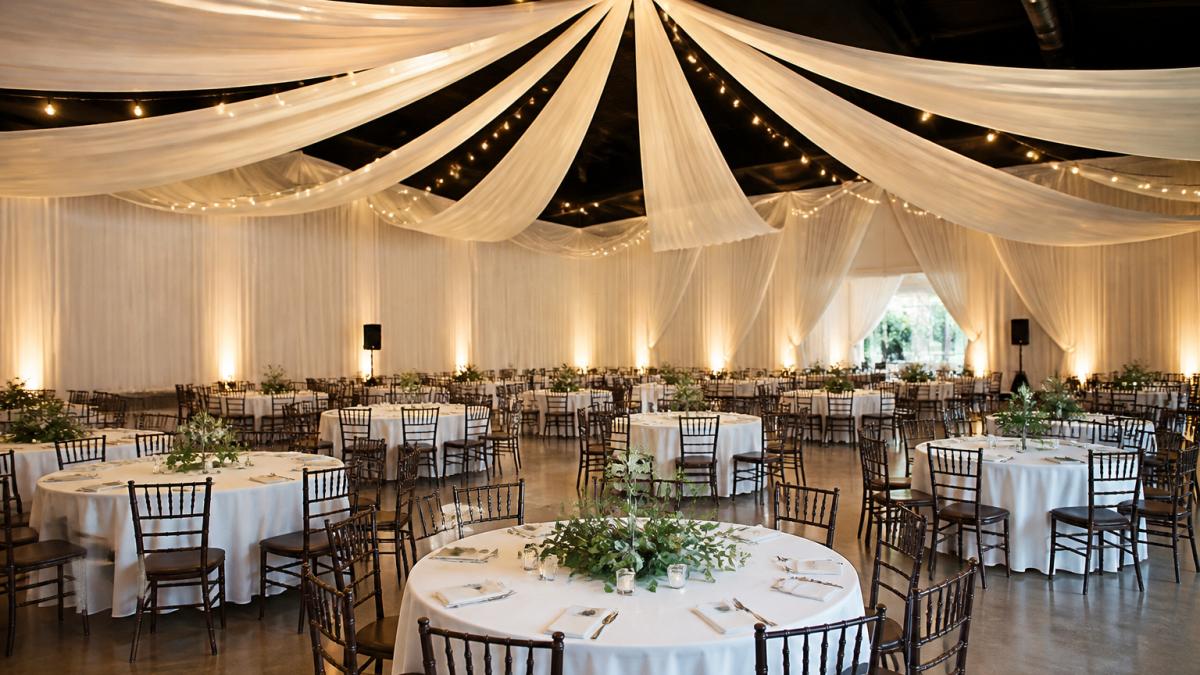
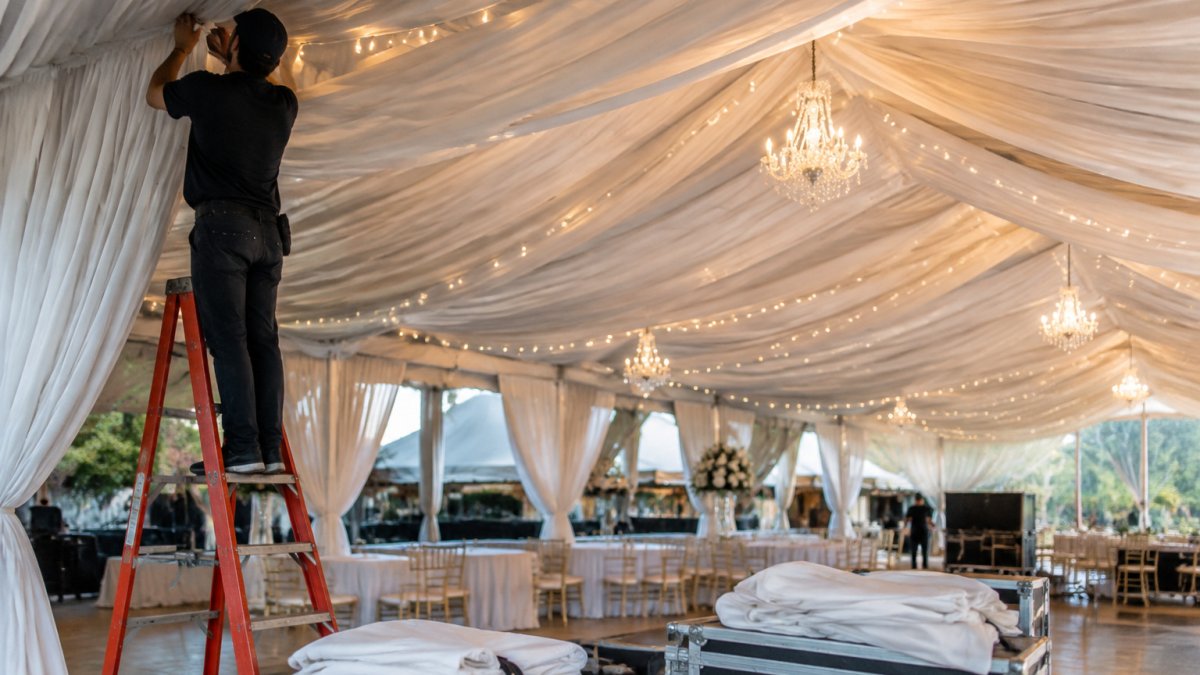
Start with the ceiling. Ceiling draping pulls a tall room down to a human scale and hides rafters, rigging, and ductwork.
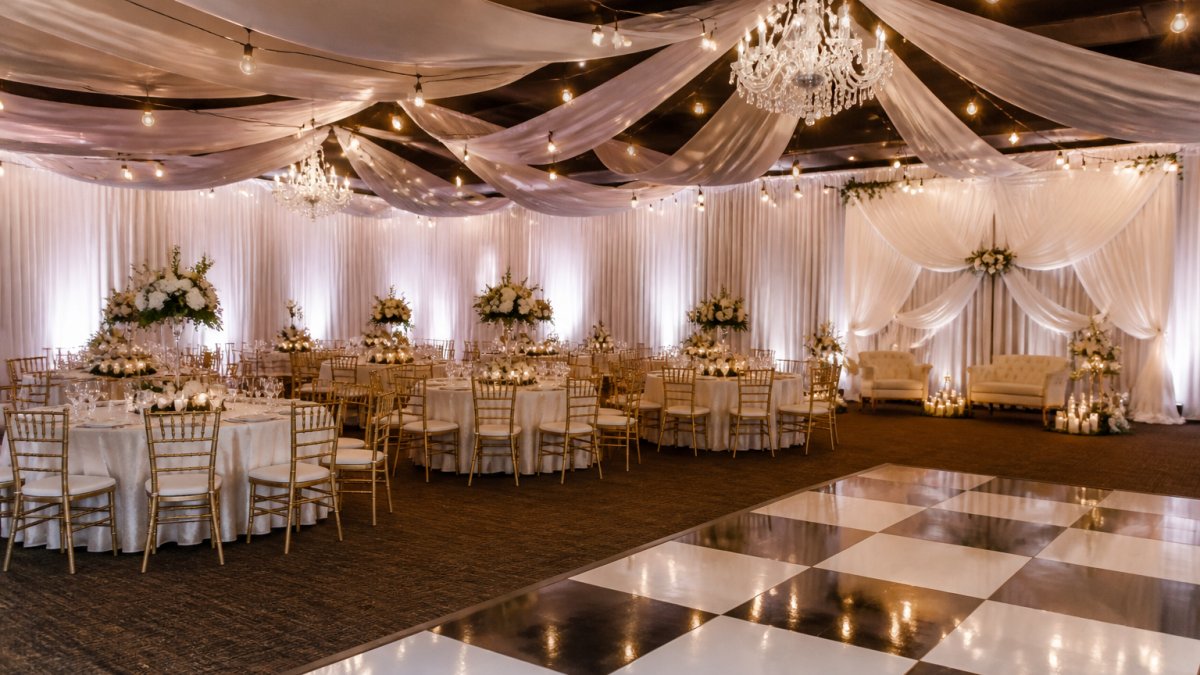
Then layer lighting above the guest level. Bistro string lights, market lights, and twinkle lights add warmth and fill visual space at a fraction of the cost of tall floral installations.
A few high-impact moves for big rooms:
- Drape the ceiling in soft panels to lower the visual height
- Run string lights in a grid or swag pattern across the room
- Use a ceremony backdrop as a focal point so the eye has somewhere to rest
How to Make a Large Venue Feel Intimate Without Spending More
Making a large venue feel intimate is a matter of shrinking sightlines, not the guest list.
The cheapest tool is grouping: push tables closer together and leave open space at the edges. A tight cluster of tables under warm light feels like a room within a room.
Lighting does the rest. Dim the house lights and let uplighting and candles carry the mood. A bright, evenly lit hall feels like a cafeteria.
Try these low-cost intimacy moves:
- Cluster reception tables instead of spacing them evenly
- Use pipe and drape to section off a lounge or sweetheart table area
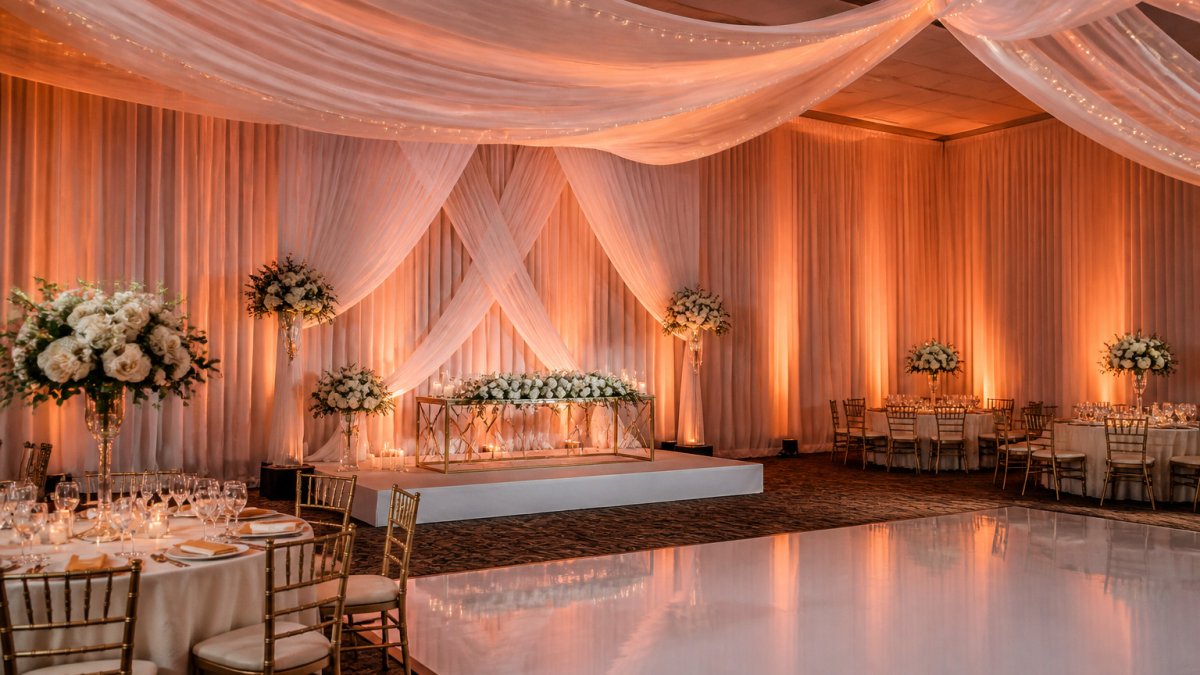
- Keep guest lighting low and warm, with amber uplighting on the walls
Wedding Lighting Ideas for Large Venues That Do the Heavy Lifting
Wedding lighting ideas for large venues should be your first budget line, not your last.
Uplighting is the workhorse: fixtures at the base of walls wash color upward and make a plain room look designed.
Overhead, bistro string light rentals and market lighting fill the air space high ceilings leave empty and give photographers a warm, even light source after sunset.
A simple lighting plan by room condition:
| Room Condition | First Lighting Move | Why It Works |
|---|---|---|
| High, bare ceiling | Ceiling draping plus string lights | Fills vertical space and hides structure |
| Cold industrial walls | Amber uplighting | Warms concrete, brick, and metal |
| Bright, flat hall | Low house lights plus uplighting | Creates depth and mood |
| Dark room with no character | Twinkle lights and market lighting | Adds sparkle and a focal glow |
| Large blank wall | Uplighting plus pipe and drape | Breaks up the surface and adds color |
Wedding Decor Budget Planning: A Tiered Framework for Big Rooms
Wedding decor budget planning for a large venue works best in tiers, because not every element carries equal weight. Rank spending by how much of the room each item changes, then size quantities to the actual room.
We use a three-tier framework:
- Tier 1: Room structure. Ceiling and wall draping, backdrops, and lighting. These change how the whole room feels. Fund these first.
- Tier 2: Focal points. The ceremony backdrop, sweetheart table backdrop, and dance floor. These anchor photos and guest attention.
- Tier 3: Table detail. Linens, runners, centerpieces, and candles. These matter most up close, so spend here last.
A common mistake is inverting the tiers: couples buy elaborate centerpieces for many tables and have nothing left to soften the ceiling.
Size the budget to the room, not the guest list
Large-venue budgets blow up because most couples plan by guest count when they should plan by surface area, two rooms with the same 200 guests can need very different amounts of material. Before you price anything, measure four numbers:
- Ceiling height at the highest and lowest points.
- Linear feet of wall you want to treat (perimeter minus doors, windows, and exits).
- Floor area in square feet, and the footprint you want the dance floor to occupy.
- Table count and shape, since linens and centerpieces scale with tables, not people.
Those four numbers let you estimate quantities instead of buying blind:
- Wall draping is priced and ordered by the linear foot of wall covered, plus height. A room with visible wall needs roughly that much fabric run, plus overlap and gather.
- Ceiling draping scales with the ceiling's square footage and the number of rigging points available, not with guest count.
- Uplighting is ordered per fixture, and fixtures are spaced along the wall perimeter. More wall means more fixtures.
A cost-per-area way to compare options
Instead of asking "what does this cost," ask "how much of the room does this change per dollar." That reframe is the most useful budget tool for a big space.
- Ceiling and wall draping touch the largest visible surface in the room, so they carry the most visual change per dollar in a tall, bare hall.
- Uplighting washes entire walls at once and is ordered per fixture, so its cost scales gently with room size compared with fabric or flowers.
- Centerpieces change only the table they sit on. In a large room, table decor is a small fraction of what guests see, which is why it belongs in Tier 3.
In a room with high ceilings and bare walls, the same spend on ceiling draping and uplighting will visibly change more of the room than spreading it across many centerpieces.
Where the budget actually leaks
Three leaks show up again and again in large rooms:
- Paying twice for what the venue includes. Many halls provide tables, chairs, and basic linens. Confirm the venue's inventory before you rent or buy any of it.
- Under-ordering fabric and lighting. Ordering to the exact measurement with no overlap or buffer means a shortfall on install day, and rush additions cost more than planning for them.
- Buying table detail before funding structure. Elaborate centerpieces with an untreated ceiling is the classic inversion, and it is the hardest to fix late.
Rental versus purchase matters here too. Renting draping, lighting, and dance floors spreads cost across one event instead of storing items you will never use again. Buying linens and small accents in bulk can stretch a tight budget, but only after the structure is funded.
Rent, Buy, or DIY? A Decision Framework for Affordable Wedding Decor
Affordable wedding decor comes down to one question per item: rent it, buy it, or make it yourself. The answer depends on size, labor, reuse, and safe installation, and in a large venue, labor and logistics usually decide it more than sticker price.
The four tests that decide it
Run every item through these four questions before you commit:
- Does it need safe rigging or power? Overhead draping, string lights, uplighting, staging, and dance floors need professional installation and safe hardware. Rent these.
- How many do you need? Small items bought in bulk, votive candles, bud vases, glass vases, table runners, paper lanterns, get cheaper per unit at wholesale quantities. Buy these.
- Will you reuse it? If the answer is no, renting spreads the cost across one event instead of leaving you with storage. If yes, buying can win.
- Can you transport, store, and set it up without risk? If any of those is a no, DIY is a false economy.
Compare total cost, not unit cost
DIY decor looks cheap on paper until you count the full cost. A fair comparison includes:
- Materials, the item itself, plus tape, wire, clips, and backup supplies.
- Labor, your hours and your helpers' hours, multiplied by a large room's setup window.
- Transport, vehicle rentals, fuel, and multiple trips for bulky items.
A large venue multiplies labor, transport, and storage at once, so an item that looks economical per unit can cost more in total than renting a professionally installed equivalent.
A practical split for big rooms
- Rent large, structural, or technical items: draping, lighting, dance floors, staging, and specialty chairs. These need professional installation and safe rigging, and they are the items most likely to fail or look unfinished if handled without the right hardware.
- Buy small, reusable items in bulk: votive candles, bud vases, glass vases, table runners, and paper lanterns. Wholesale and bulk purchasing cut the per-unit cost, and these are easy to transport and store.
- DIY only what you can transport, store, and set up without risk: simple centerpieces, signage, and small decorative accents.
For greenery and florals, a mix works well: real foliage where guests get close, and lower-cost greenery and bud-vase arrangements on distant tables, the same cost-per-area logic that governs the rest of a large-room budget.
The labor math most couples miss
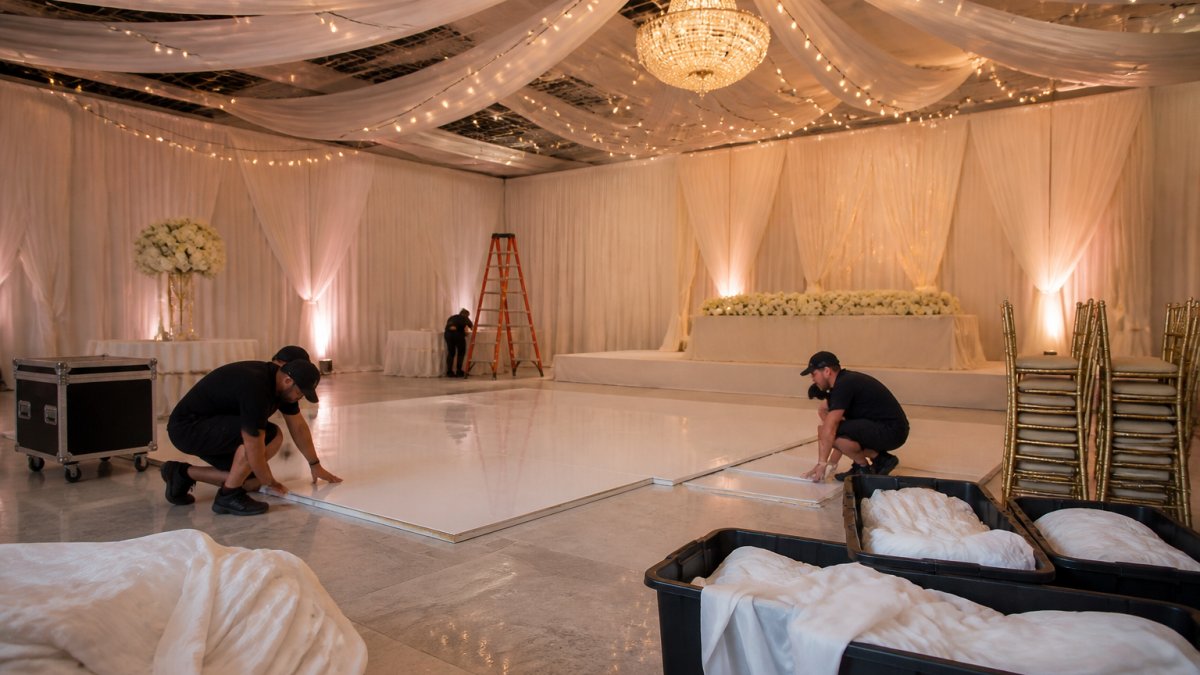
A large room usually comes with a short installation window and a same-night teardown, compressing every DIY task into a few hours with limited hands. Professional crews arrive with the right hardware, rig safely, and finish in the time the venue allows, which matters most for ceiling draping, overhead lighting, and staging.
Setup, Teardown, and Logistics: The Hidden Cost of Cheap Decor
Setup and teardown is where budget decor plans quietly fall apart.
Plan the logistics before you buy anything:
- Confirm load-in and load-out times with the venue
- Check whether the venue allows rigging and what hardware is needed
- Measure the room and count tables before ordering linens or centerpieces
That last point catches many couples: some venues restrict open flame, making battery-powered options the safer pick.
Storage is the other quiet cost: bulk purchases of vases, lanterns, and linens need a place to live before and after the event.
A large venue does not have to mean a large bill.
Frequently Asked Questions
How can I decorate a large wedding venue affordably?
Focus your affordable wedding decor on the areas guests see most: the entrance, ceremony backdrop, and reception tables. Use rental draping and lighting to cover large walls and high ceilings, which costs less than filling the same space with florals. Choose greenery and candles over fresh arrangements, buy linens and votives in bulk, and put your budget toward one or two high-impact zones instead of spreading it thin across the whole room.
What is a good budget for wedding decor?
There is no single number, because decor budgets depend on guest count, venue size, and how much you rent versus buy. A common approach is to set a total wedding budget first, then allocate a realistic share to decor and rentals before you book anything. Build a tiered plan with must-have, nice-to-have, and optional items, and request quotes early so you can compare real numbers instead of guessing.
How do you make a large wedding venue feel more intimate?
Break the room into smaller zones with draping, lighting, and furniture placement. Lower the visual ceiling with hanging fabric or string lights, use warm amber uplighting on walls, and cluster reception tables closer together rather than spreading them out. A cozy lounge area and a clearly defined dance floor also help. These rental-based moves shrink the perceived space without shrinking your guest list.
What wedding decorations make the biggest impact in a large space?
Draping, lighting, and a strong backdrop deliver the most visual impact per dollar in a large venue. Ceiling and wall draping softens hard surfaces and hides unattractive walls, while uplighting and bistro string lights change the mood of the entire room. A decorated ceremony backdrop and sweetheart table backdrop give guests a clear focal point, and a seamless dance floor ties the design together.