 how-to
Lighting and Draping for Weddings: 2026 Planning Guide
Table of Contents
- Start With a Lighting and Draping Plan, Not a Shopping List
- Wedding Lighting and Draping Ideas That Work in Real Venues
- Ceiling Draping for Weddings: Fabric, Layout, and the Tent-Like Effect
- Wedding Uplighting Rentals: Color, Placement, and Coverage
- Event Draping and Lighting Packages: What to Combine and Why
- Installation Logistics, Safety, and Venue Approvals
- DIY vs Professional Installation: An Honest Comparison
- Conclusion: Build the Room Before You Decorate It
- Frequently Asked Questions
Last Updated: October 14, 2026
Start With a Lighting and Draping Plan, Not a Shopping List
Most couples begin with a saved photo and work backward, which is why so many receptions look like a rental catalog exploded in the room.
At XL Entertainment Systems, we have watched that sequence play out across Southern California venues since 1992.
A lighting and draping plan assigns a fabric treatment and a light source to each part of the evening: ceremony, cocktail hour, dinner, toasts, dancing.
- What should the room feel like when guests walk in?
- Where does the eye need to travel during the ceremony?
- What changes when the dancing starts?
Walk the Venue and Map the Moments
Visit the venue at the same hour as your event, if the coordinator allows it. Note where daylight enters, which walls are already beautiful, and which ones need covering.
Then walk your timeline in the space. Ceremony at 4, cocktails at 5, dinner at 6:30. Mark where the light will be at each point. A room that glows at 8 p.m. can look flat and gray at 5.
Wedding Lighting and Draping Ideas That Work in Real Venues
Wedding lighting and draping ideas succeed or fail based on the architecture around them. A treatment that transforms a barn reads as clutter in a glass-walled hotel. Match the approach to the shell of the room first, then to the light already in it. Three variables decide almost everything: ceiling height, how much daylight the room holds at your start time, and what is already mounted overhead.
Start With Ceiling Height and Existing Rigging
Ceiling height sets the draping style you can actually use. As a working rule, rooms under about 12 feet do best with perimeter or partial treatments, because a full canopy drops the visual ceiling and can make the space feel compressed.
Existing rigging matters just as much. Chandeliers, exposed beams, truss, and sprinkler lines become attachment points or obstacles. A beam grid can support a channel design with almost no new hardware, while a smooth, finished ceiling may require a freestanding pipe and drape system instead, changing both the look and the load-in plan.
Industrial and Loft Spaces
Exposed brick, steel beams, and concrete floors read cold in photographs. Warm them with ceiling draping that softens the hard lines overhead, then wash the brick with amber uplighting, which flatters brick and wood in a way cooler tones cannot. Lofts also have tall windows and hard reflective surfaces, so if your event starts before sunset, plan for daylight to fight your uplighting for the first hour.
Ballrooms, Barns, and Tents
Ballrooms usually need vertical interest: wall draping, a defined backdrop, and a ceiling treatment that pulls the eye up. Barns and tents already have texture, so a light hand with chiffon and a generous run of string lights does more than heavy layering. Tents add wind and weather, so attachment points must be secure and fixtures rated for outdoor use.
| Venue Type | Draping Focus | Lighting Focus | Key Constraint |
|---|---|---|---|
| Industrial loft | Ceiling canopy, wall softening | Amber uplighting on brick | Daylight through tall windows |
| Hotel ballroom | Wall and stage draping | Uplighting plus monogram | Finished ceiling, limited rigging |
| Barn | Minimal fabric, defined backdrop | Bistro and market lights | Low beams, limited power |
| Tent | Full ceiling draping | Warm wash, dimmable | Wind, weather, outdoor-rated fixtures |
Keep Sightlines and Exits Clear
Whatever treatment you choose, guests still need to see the ceremony, reach the bar, and find the exits. Draping that blocks a sightline to the head table or a path to an exit is a real problem, not just a design one. Walk the room from a guest's seat and the back row before finalizing any layout, and leave accessible routes and exit signage unobstructed.
Ceiling Draping for Weddings: Fabric, Layout, and the Tent-Like Effect
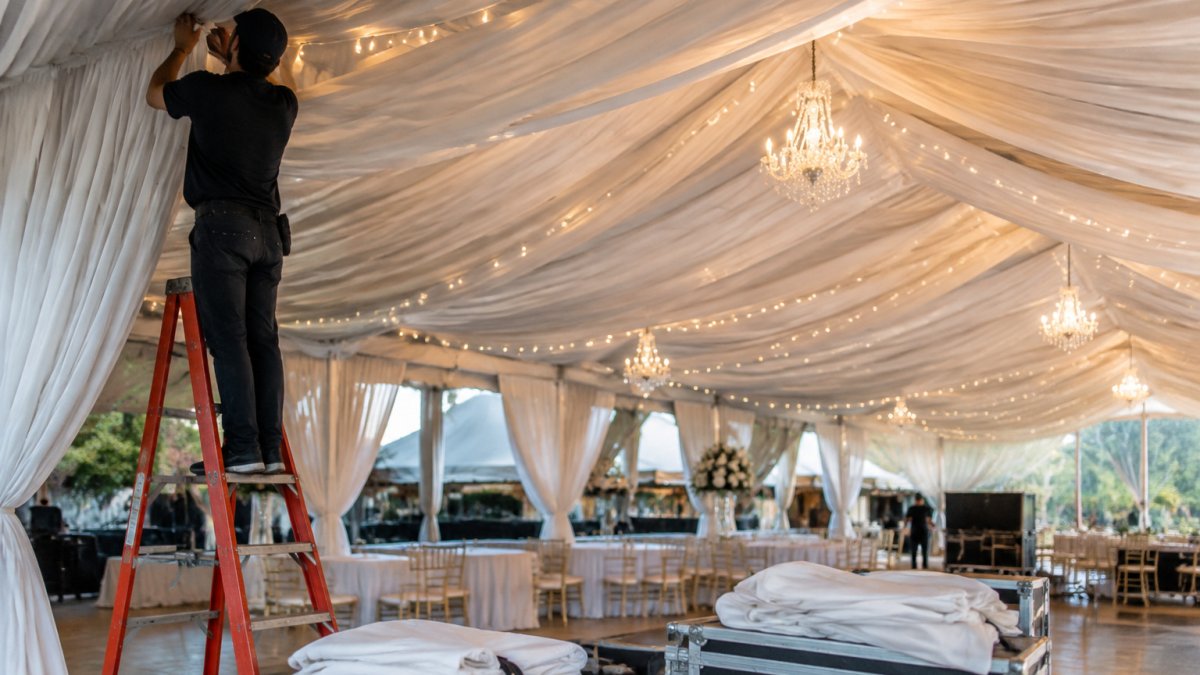
Ceiling draping for weddings changes a room more than any other treatment, replacing the ceiling with soft, glowing fabric. The tent-like effect comes from tension and height, not the amount of fabric you buy.
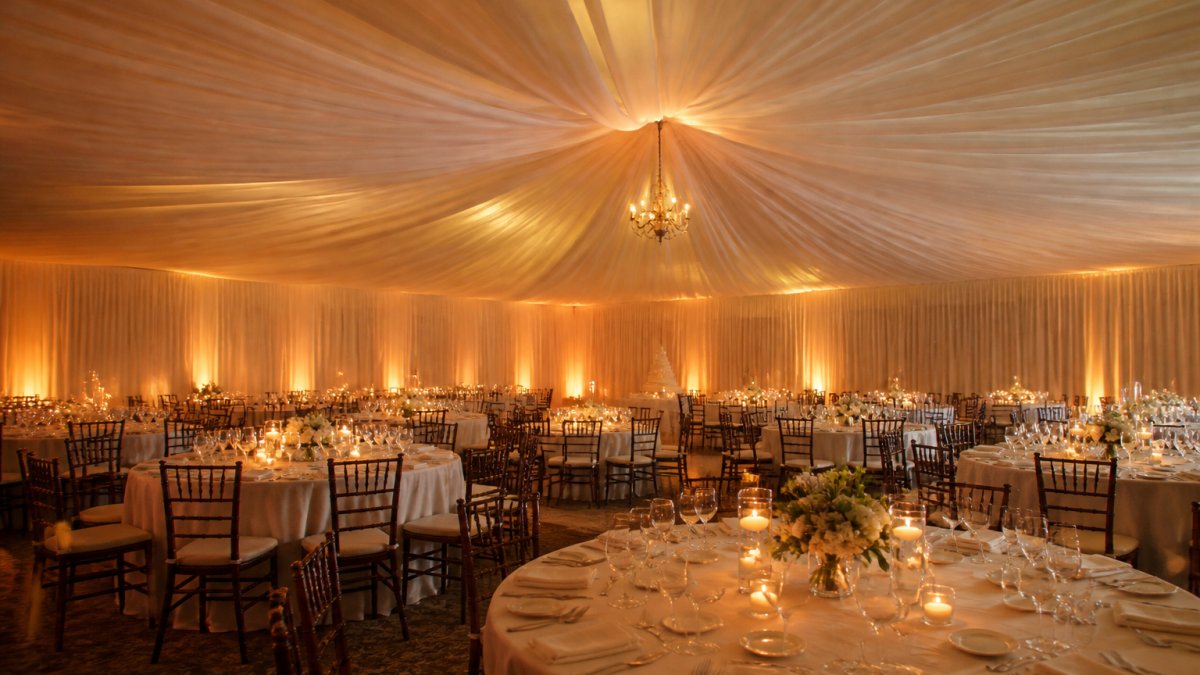
Layouts fall into three families. A radial design pulls fabric from a center point outward, suiting round rooms and creating a starry canopy.
Chiffon, Tulle, and Satin: What Each Fabric Does
Chiffon is the workhorse: soft, flowing folds that catch uplighting beautifully and read as elegant without looking heavy. Tulle is sheer and airy, creating volume and a dreamy, cloud-like effect for ceremony arches and romantic ceiling accents. Satin has a smooth sheen and holds a crisp, defined fold, suiting structured backdrops and modern designs, but it reflects light sharply and needs careful placement near uplights.
Wedding Uplighting Rentals: Color, Placement, and Coverage
Wedding uplighting rentals do more for a reception than any other single fixture, setting the mood of the entire room in one pass. But uplighting works best as one layer in a small system, not a standalone effect. Understanding how the layers fit together separates a room that glows from one that just looks lit.
Layer Ambient, Accent, and Task Light
Think of reception lighting in three layers. Ambient light is the general wash that lets guests see and move, chandeliers, overhead fixtures, or a soft uplight wash on the walls. Accent light is the directional, decorative layer: pin spots on centerpieces, a monogram on the wall, uplighting on a feature wall. Task light is functional: the glow over the bar, the path to the restrooms, the light on the cake table.
Color Temperature and Dimming
Color temperature describes how warm or cool a white light looks, measured in kelvin. Warm white, roughly 2700K to 3000K, reads as candlelit and romantic and pairs naturally with amber uplighting. Cooler whites, around 4000K and up, read as crisp and modern but can look clinical against soft fabric. Dimming makes a single setup work all evening: a room bright enough for dinner is usually too bright for dancing.
Placement and Coverage
Placement matters more than color choice: fixtures aimed at the wrong wall waste light no matter the shade. Space fixtures along the walls you want to feature, aimed upward at a slight angle so the beam washes the surface. Cover the walls behind the head table and the dance floor first, the two areas guests look at most. Taller walls and higher ceilings need fixtures placed closer together or aimed with a wider beam so the wash stays even without dark gaps; a common pattern is to space fixtures evenly and adjust the beam angle rather than the count.
Color Sets the Tone
Amber and warm white create the romantic, candlelit feel most receptions want. Soft blush and champagne flatter skin tones in photos. Deep blues and purples suit evening dancing but can read cold during dinner, which is why many couples switch colors between courses. If you plan a mid-event change, confirm the fixtures support it and that someone is assigned to make it, a color switch that happens late or not at all is worse than choosing one color and leaving it.
Event Draping and Lighting Packages: What to Combine and Why
Event draping and lighting packages work because fabric and light are co-dependent. Draping without lighting looks flat and gray. Lighting without draping has nothing to catch it. Combining them is where a room transforms.
The combinations that deliver the most impact:
- Ceiling draping plus amber uplighting: softens the ceiling and warms the walls at once.
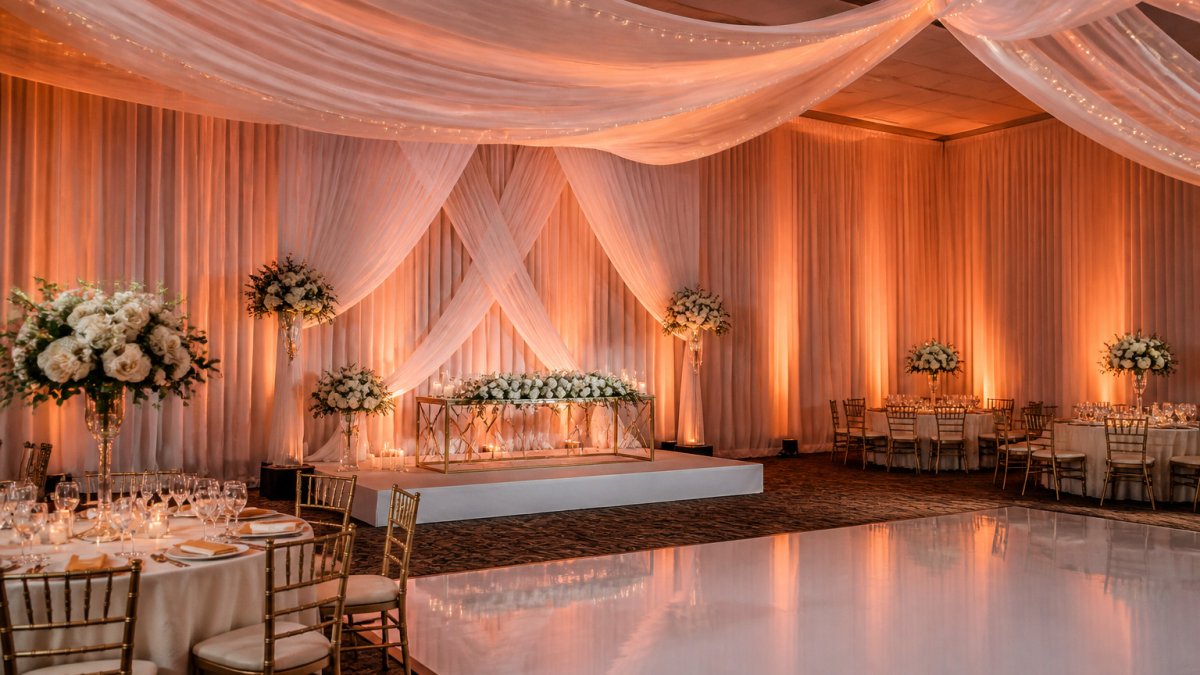
- Wall draping plus a monogram light: gives the room a focal point guests photograph.
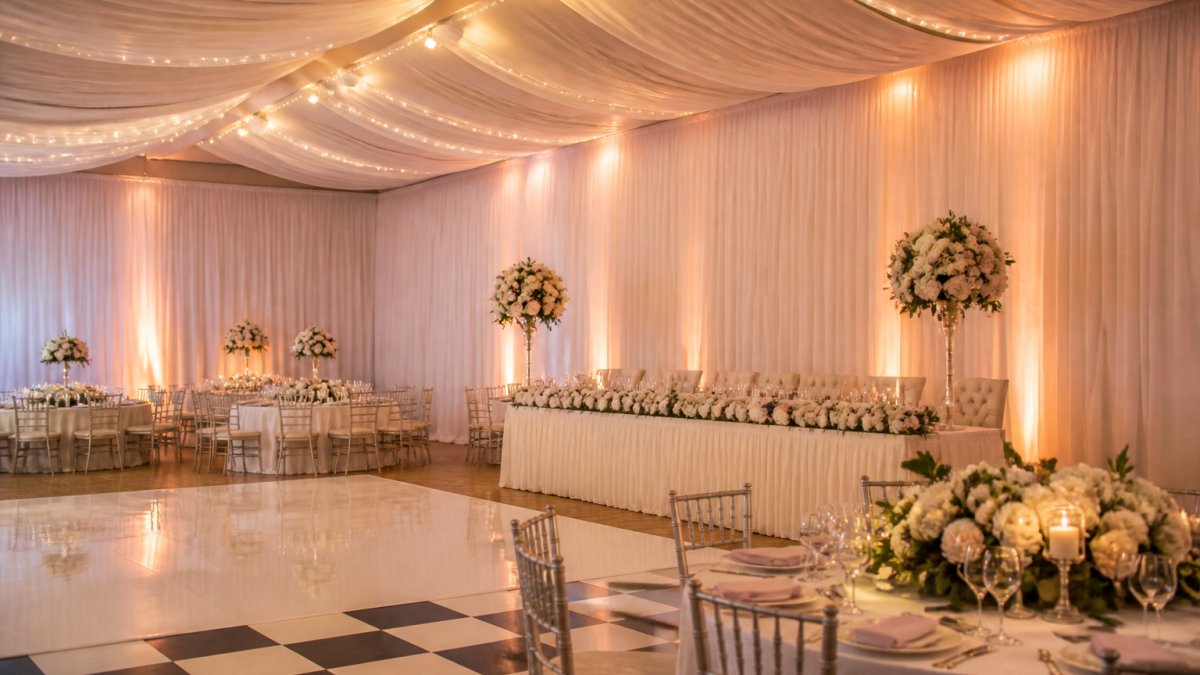
- Bistro and market lights plus a sheer ceiling canopy: the classic tent-like glow.
For a full reception transformation, pair draping and lighting with a seamless white dance floor and matching chair rentals. A white floor reflects uplighting back into the room, which makes the whole space feel brighter without adding fixtures.
Installation Logistics, Safety, and Venue Approvals
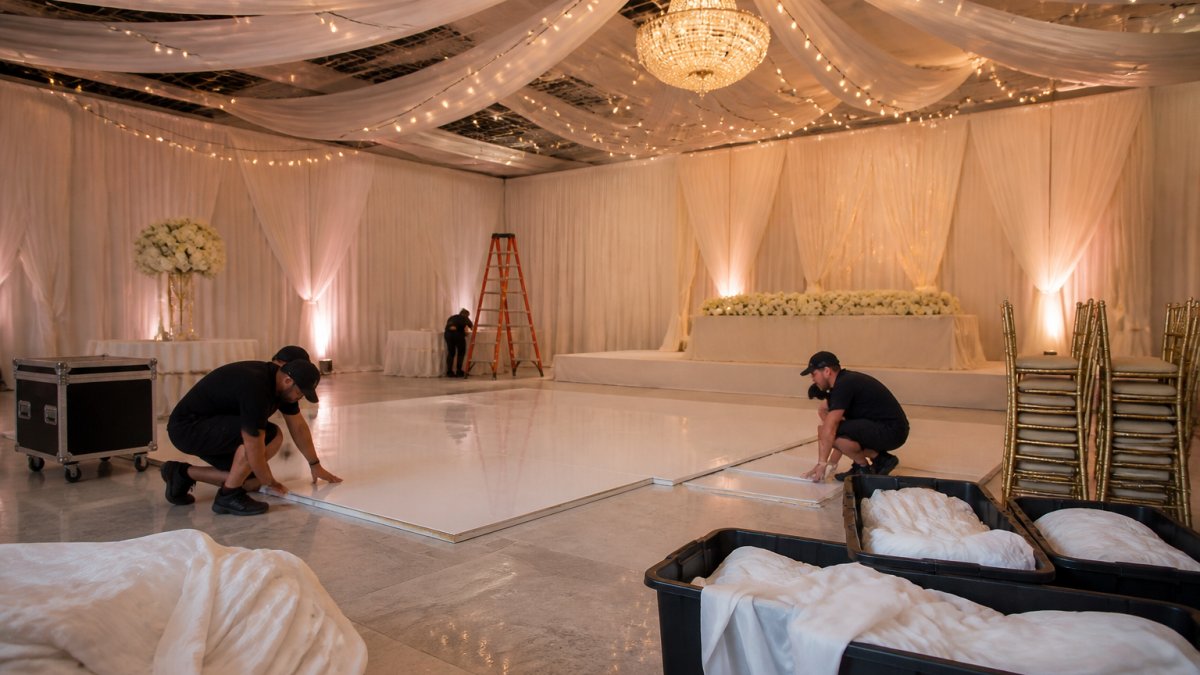
Drape installation is a rigging job, not a decorating job, and it comes with real requirements. Venues typically require proof of insurance from any vendor working at height, and many require rigging be attached only at approved points.
Other logistics to settle early:
- Load-in and load-out windows, including elevator and dock access
- Whether the venue supplies rigging points or your vendor must bring them
- Setup time needed before guests arrive and teardown time after they leave
Getting these answers weeks ahead prevents the most common day-of problem: a setup crew waiting on access while the ceremony start time closes in.
DIY vs Professional Installation: An Honest Comparison
DIY draping looks appealing until you price the hardware and count the hours. For a small backdrop or single arch, doing it yourself is reasonable. For ceiling work in a ballroom, it usually is not.
| Factor | DIY | Professional Installation |
|---|---|---|
| Best for | Small backdrops, arches | Ceilings, walls, stages |
| Equipment | Purchased or rented | Commercial pipe and drape |
| Height access | Ladders, risk | Proper rigging and lifts |
| Insurance | Usually none | Certificate provided |
| Setup time | Hours, often longer | Scheduled and crewed |
| Day-of risk | High | Managed by the vendor |
The honest trade-off: DIY saves on labor but costs time, safety margin, and the ability to fix a problem on the day. Professional installation costs more upfront and removes the risk.
Conclusion: Build the Room Before You Decorate It
The couples who end up with a room that feels finished planned the space before they picked the pieces. Start with the venue walk-through, map your moments, then choose fabric and light together.
That is exactly how we work at XL Entertainment Systems. As a family-owned company serving Southern California since 1992, we handle ceiling and wall draping, wedding uplighting, bistro and market lighting, dance floors, and chair rentals as one coordinated design, with professional installation and a free custom quote.
Frequently Asked Questions
How expensive is draping for a wedding?
Draping is quoted per project, so the number depends on how much fabric you need, the height of the room, the layout, and whether installation is included. A single backdrop costs far less than wrapping an entire ballroom ceiling. Instead of guessing from online averages, share your venue name, ceiling height, and the areas you want covered, and request a written quote. That way you compare real numbers for your actual space rather than a generic figure that may not apply.
What color is most flattering for uplighting at a wedding?
Warm amber and soft champagne tones flatter skin tones and photographs, which is why they remain the most requested uplighting colors for receptions. Whites and soft pinks read clean and romantic in ballrooms. Deep blues, purples, and greens create drama but can cast unflattering shadows on faces if used as the only light source. A practical approach is warm amber or blush for dinner and toasts, then a richer color for dancing once the formal moments are finished.
Can uplighting be used with wedding draping?
Yes, and the two are usually stronger together. Uplights placed at the base of a draped wall wash the fabric from below, so folds and texture become visible instead of flat. The effect works best when the fixtures sit a short distance from the wall and are aimed at the fabric rather than the ceiling. For ceiling draping for weddings, add pin spotting or string lights above so the room has both a glowing perimeter and a lit canopy.
How do you plan lighting and draping for a wedding?
Start by walking the venue with your rental company and noting ceiling height, mounting points, wall surfaces, and existing light you cannot turn off. Decide which moments need which look: ceremony, cocktail hour, dinner, toasts, and dancing. Choose fabrics and colors that match the room rather than fight it, then layer ambient, accent, and decorative lighting so no single source carries the whole room. Confirm power access, setup windows, and venue approval before booking.