 how-to
Tips for Draping Large Event Spaces: Layout to Install
Table of Contents
- Why Large Event Draping Changes the Room Before Anything Else Does
- How to Calculate Fabric for Large Event Draping
- Event Ceiling Draping: Turning a Tall Hall Into a Room
- Event Wall Draping: Covering Brick, Glass, and Everything in Between
- Draping and Uplighting Ideas That Make a Big Room Feel Intimate
- Installation Day: How a Large-Space Drape Plan Comes Together
- Rent or Buy? Budget Decisions for Large Event Draping
- What to Ask an Event Draping Company Before You Book
- Frequently Asked Questions
Last Updated: October 14, 2026
Why Large Event Draping Changes the Room Before Anything Else Does
Walk into an empty banquet hall and you see the truth: concrete floors, exposed ductwork, fluorescent wash. Fabric changes that in an afternoon.
At XL Entertainment Systems, we have draped ballrooms, warehouses, and hotel ballrooms across Orange County, Los Angeles, Riverside, and San Bernardino counties since 1992, and the pattern never changes: guests remember how a room felt, not how it was decorated.
Event safety guidance from the National Fire Protection Association treats decorative fabric as a regulated material in public assembly spaces, which is why professional draping is as much about compliance as it is about beauty.
How to Calculate Fabric for Large Event Draping
Fabric quantity is the most common reason a large-space drape plan fails. Order too little and you get gaps at the seams; order too much and you pay for fabric that never leaves the crate.
The calculation is straightforward. Measure the width you need to cover, then multiply by your fullness ratio. A flat panel uses a 1:1 ratio and looks like a bedsheet.
Fullness, Pleating, and Finish: The Numbers That Decide Coverage
Work through the numbers in this order:
- Measure the full span in feet, wall to wall or beam to beam
- Choose fullness: 1.5:1 for a soft look, 2:1 for standard elegance, 3:1 for dense, structured pleating
- Add 10 to 15 percent for hemming, seams, and tie-offs
| Fullness Ratio | Look | Best For |
|---|---|---|
| 1.5:1 | Light, airy folds | Casual celebrations, outdoor tents |
| 2:1 | Classic gathered drape | Weddings, galas, most ballrooms |
| 3:1 | Dense, formal pleating | Black-tie events, stage backdrops |
A common mistake is measuring the floor and forgetting the ceiling. A 30-foot wall in a room with 18-foot ceilings needs panels cut to height, which changes your order completely.
Event Ceiling Draping: Turning a Tall Hall Into a Room
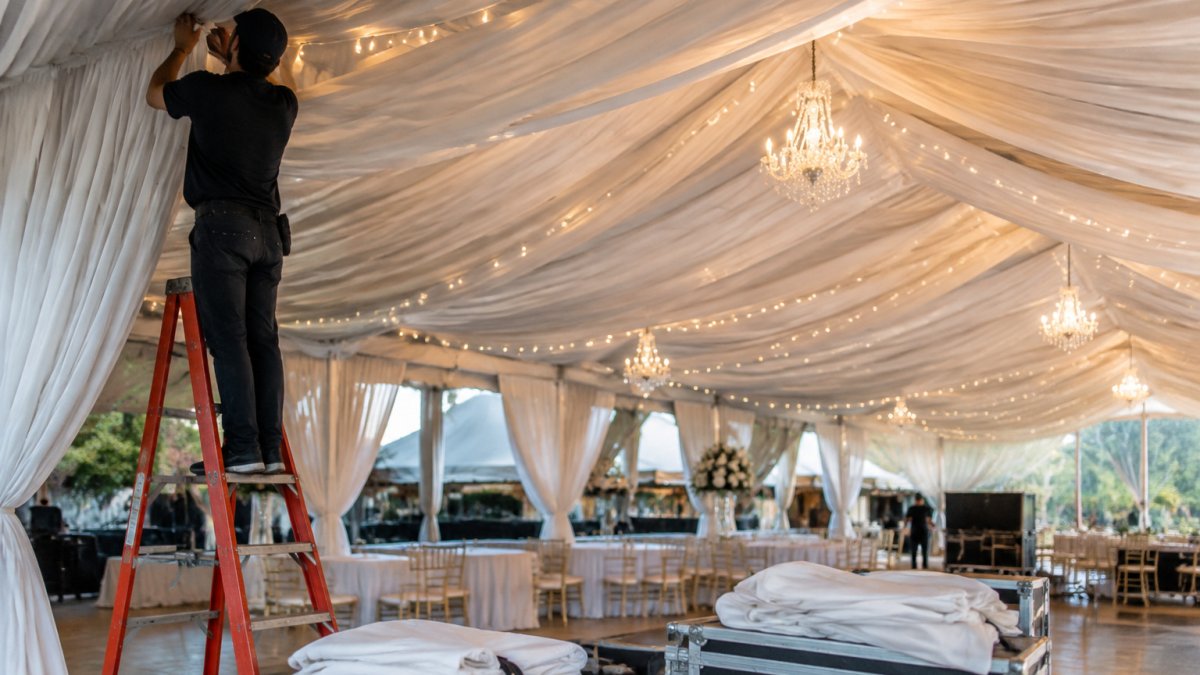
Ceiling draping lowers the visual ceiling without touching the building. A 30-foot warehouse feels cavernous until fabric runs overhead at 12 feet, and suddenly the same square footage reads as intimate.
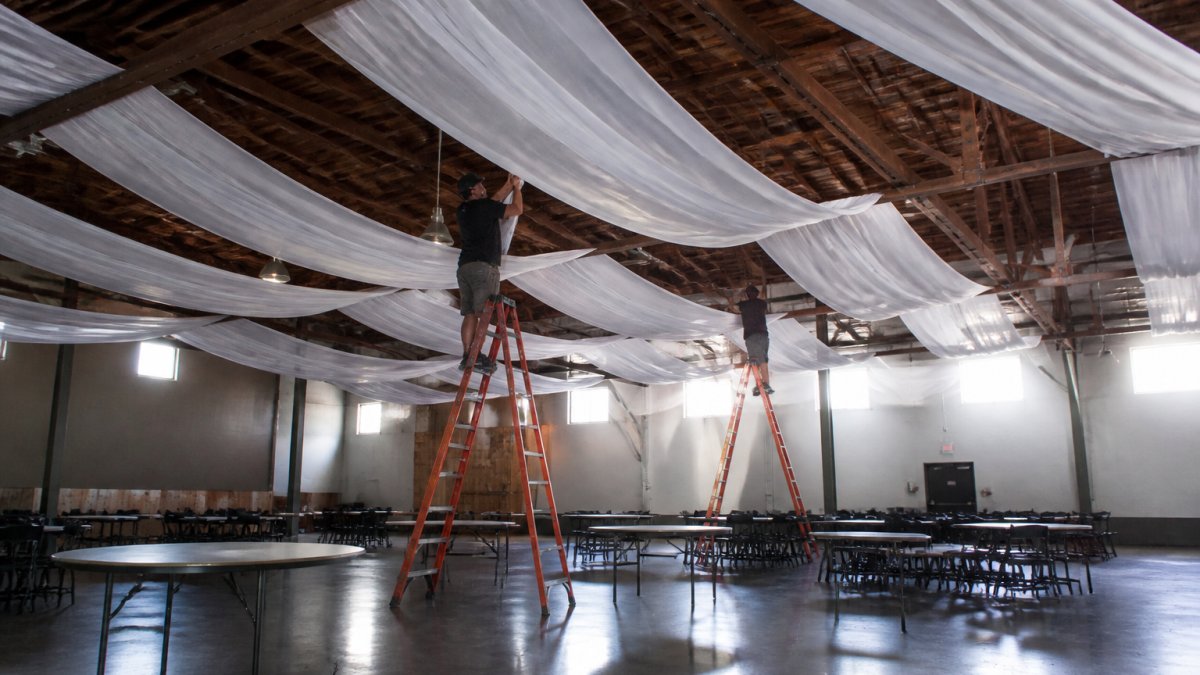
We typically run ceiling fabric in various patterns, such as a full flat stretch for a clean canopy, gathered swags radiating from a center point, or parallel panels that follow the room's existing beams.
Rigging Safety, Venue Rules, and Fire Codes to Confirm First
Before anyone climbs a ladder, confirm three things with the venue: where you are allowed to attach anything, whether the venue requires a certificate of insurance from your rigging crew, and what the local fire code requires for decorative fabric in a public assembly space.
Fire code requirements for interior finishes and decorations from the National Fire Protection Association generally call for flame-resistant or treated materials in assembly occupancies. Ask the venue for its written requirements before you order fabric, not after.
Event Wall Draping: Covering Brick, Glass, and Everything in Between
Wall draping solves the problem ceilings cannot: surfaces you cannot change. Exposed brick, glass curtain walls, and mirrored panels all fight a soft, romantic look, and fabric is the fastest way to win.
The approach depends on the surface. Brick and concrete take freestanding pipe and drape frames, which need no drilling. Glass walls work best with sheer panels that diffuse daylight.
Floor-to-ceiling drapes do more than cover. They define where the ceremony ends and the reception begins, which matters enormously in a large venue with no built-in room division.
Draping and Uplighting Ideas That Make a Big Room Feel Intimate
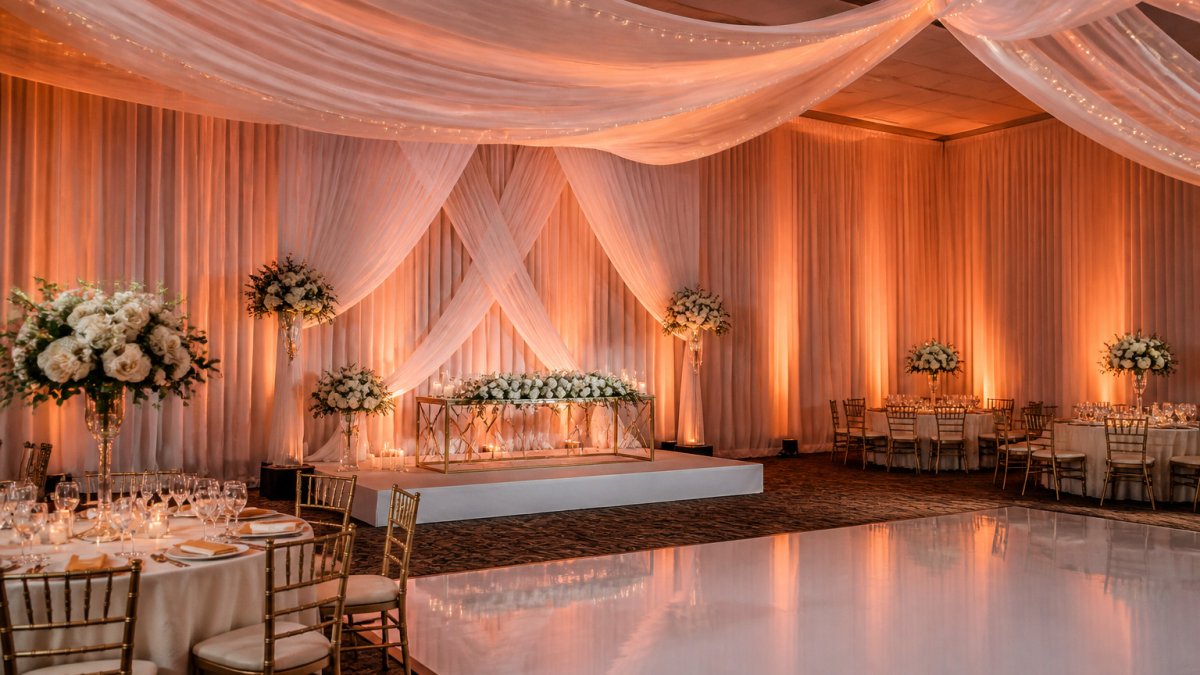
Uplighting turns fabric from a backdrop into an atmosphere. The same white drape reads as crisp and modern under cool light, and warm and romantic under amber. One rental, two completely different weddings.
What separates a room that glows from a room that looks spotted is fixture placement and beam control. Three variables do most of the work:
- Throw distance. A typical LED uplight throws a usable wash roughly 8 to 15 feet up a wall. If your ceiling is 20 feet, a fixture sitting on the floor will fade out before it reaches the top of the drape. The fix is either a longer-throw fixture or mounting the light on a truss or pipe at mid-height.
- Beam angle. A narrow beam (around 15 to 25 degrees) creates a tight column of light, which is dramatic on a tall wall but leaves dark gaps between fixtures. A wide beam (around 40 to 60 degrees) blends into a smooth wash but loses intensity over distance. Most large ballrooms land on a mid-range beam with fixtures spaced 6 to 10 feet apart.
- Fixture count. A common pattern for uplighting is one fixture per 6 to 10 linear feet of draped wall, with adjustments for very tall ceilings or very saturated colors. Saturated reds and deep blues often need more fixtures than amber or warm white to read evenly.
Pairings That Work in Large Rooms
- White ceiling drapes with amber uplighting for a warm, candlelit feel in a large hall
- Sheer wall panels with a cool blue or lavender wash for a modern, elegant reception
- Bistro and string lights layered under ceiling fabric for a soft, twinkling canopy
Why Fabric Finish Changes the Lighting Plan
Matte fabrics absorb light and read flat. Fabrics with a slight sheen can bounce uplighting back into the room and make the space feel brighter, which can be beneficial in rooms with dark walls or low ceilings. If covering a mirrored or dark-paneled wall, planning on more fixtures or a lighter fabric can be effective.
Intelligent Lighting and Layering
Static uplights set a base color. Intelligent fixtures add movement, color changes between ceremony and reception, and the ability to shift a room from romantic to high-energy without re-rigging.
If your venue has existing house lighting, ask whether it can be dimmed independently. Uplighting looks best when the room's overhead lights are low, and a venue that cannot dim its house lights will wash out even a well-planned design.
Installation Day: How a Large-Space Drape Plan Comes Together
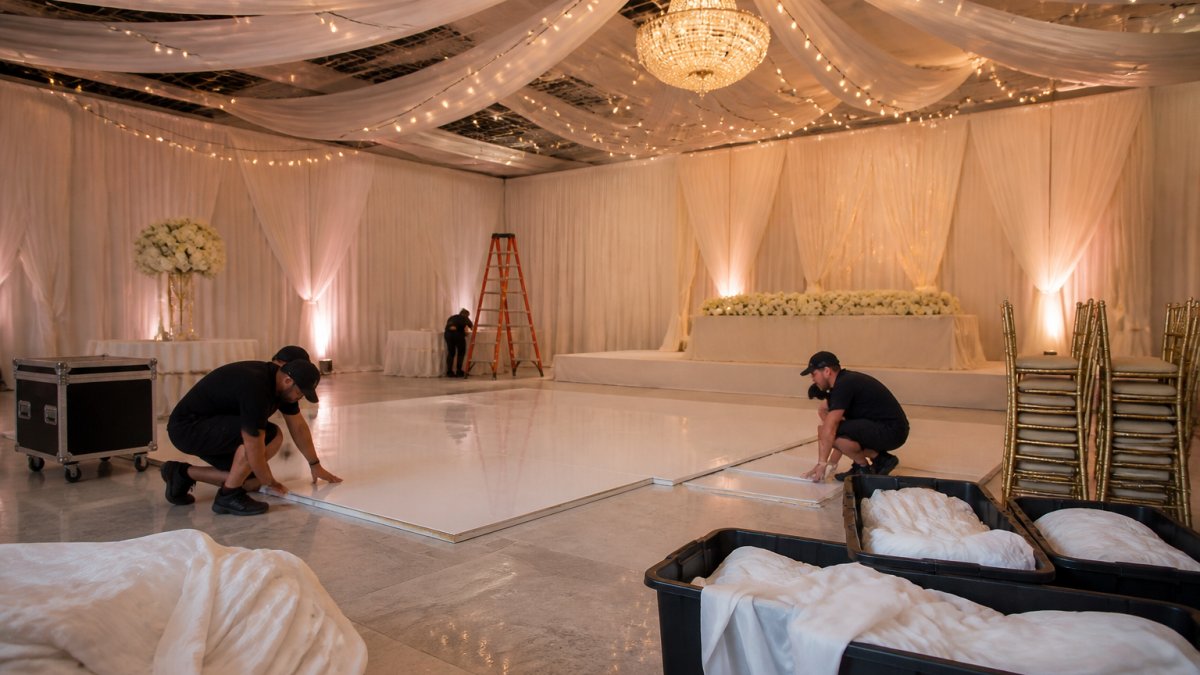
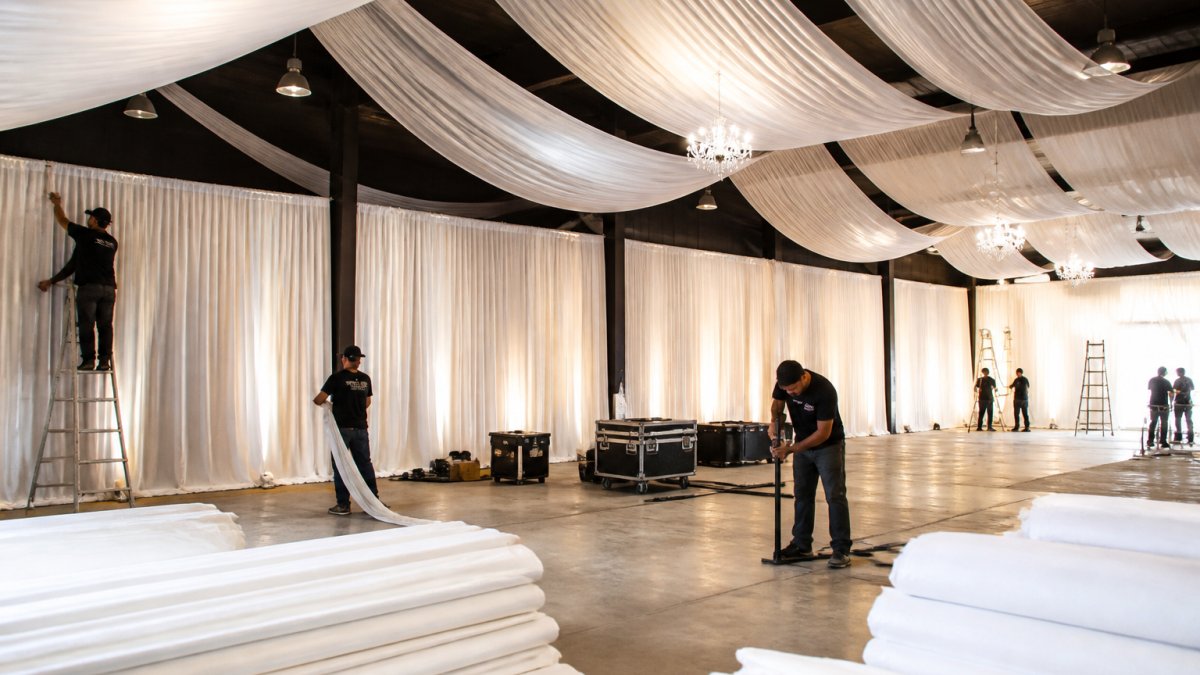
Large-space installation is a sequence, not a scramble. Get the order wrong and you are re-hanging panels while the caterer waits.
- Walk the room and mark every attachment point and frame position
- Set rigging and frames first, before any fabric comes out of the crate
- Hang ceiling drapes from the top down, working outward from the center
- Install wall drapes and backdrops, checking fullness as you go
- Steam or release fabric folds so panels hang evenly
- Add lighting last, then adjust angles once the room is dark
Expected Result: Even panels, no visible seams, and lighting that reads the same from every table.
The venue's load-in window usually decides the schedule, so confirm it early.
Rent or Buy? Budget Decisions for Large Event Draping
Renting wins for almost every one-time event. Buying fabric for a single large space means paying for material, then paying again for someone to cut, hem, and rig it, then storing it afterward. For a one-day celebration, that is three costs to solve one problem.
Renting makes sense when you need the fabric once, want professional installation, or need the quantity a large room demands.
What Actually Drives the Quote
No two large-space quotes look alike because the inputs change. The main drivers:
- Linear feet of coverage. Wall draping is priced by the running foot; ceiling draping is priced by the square foot of overhead coverage plus rigging.
- Ceiling height. Tall rooms need longer panels and more rigging labor, which is the single biggest swing factor in a large-space quote.
- Fullness ratio. A 3:1 dense pleat uses roughly twice the fabric of a 1.5:1 soft fold for the same span.
How to Prioritize When the Budget Is Fixed
If the full plan does not fit the budget, cut in this order:
- Keep the focal point. The ceremony backdrop, stage, or head-table wall is what guests photograph. Protect it first.
- Cover the ugliest wall, not every wall. One fully draped wall reads as intentional; four half-draped walls read as unfinished.
- Use ceiling draping as a partial canopy. A centered overhead installation over the dance floor or head table delivers most of the intimacy of a full ceiling for a fraction of the coverage.
- Trade density for span. A 2:1 fullness across a wider wall usually looks better than 3:1 across a narrow one.
- Add lighting before adding more fabric. Uplighting on an existing drape often does more for the room than another panel of fabric.
Questions to Ask Before You Sign
Ask for a written quote that itemizes fabric, rigging, labor, lighting, delivery, and teardown rather than a single lump figure. Then confirm:
- What is included in setup and teardown, and what triggers an overtime charge?
- Who is responsible if the venue changes the load-in time?
- Is the quote based on a site visit, or on your description of the room?
Guidance on event contracts and vendor agreements from the Better Business Bureau is worth reading before you sign, particularly around cancellation terms and setup responsibilities.
A site visit is the best way to avoid a surprise on the quote. Measurements taken from a photo or floor plan miss beam heights, column placement, and outlet locations, and those details move a large-space project from straightforward to complicated.
What to Ask an Event Draping Company Before You Book
Ask these questions before you put down a deposit, and pay attention to how specific the answers are.
- Do you carry insurance, and can you provide a certificate for the venue?
- Is your fabric flame-resistant or treated to meet fire code?
- Who handles rigging, and are they trained for overhead work?
A vendor who hesitates on insurance or fire code has not worked many large rooms. The right answers are short and confident.
XL Entertainment Systems has handled ceiling draping, wall draping, backdrops, uplighting, and dance floors across Orange County, Los Angeles, Riverside, and San Bernardino counties for more than 30 years.
A large room does not have to feel cold, echoing, or unfinished.
Frequently Asked Questions
How do you drape a large event space?
Start with a plan, not fabric. Measure the room's length, width, and ceiling height, mark the zones you want to define (ceremony, dining, dance floor), then choose anchor points: ceiling beams or a pipe and drape system for overhead work, freestanding frames or wall anchors for wall draping. Fullness, drape height, and lighting are set next, and installation usually happens the day before or the morning of the event. A professional crew can dress a large hall in a few hours.
How do you calculate how much fabric is needed for event draping?
Measure the width you're covering, then multiply by your fullness ratio: 1.5x for a light, airy look, 2x for standard pleating, and 2.5x to 3x for dense, formal swags. For a 40-foot wall, that's roughly 80 feet of fabric at 2x fullness. Always round up, add extra for tie-backs and overlap at anchor points, and let a rental company confirm the final yardage, since fabric width and panel count change the math.
Can you drape a venue ceiling safely?
Yes, when it's done with the venue's approval and proper rigging. Before booking, confirm what the venue allows you to attach to, whether a licensed rigger is required, and what fire-rating documentation they need for textiles. Never hang fabric from sprinkler heads, electrical conduit, or HVAC ducts. Reputable draping companies carry the right hardware, know local fire codes, and handle the venue paperwork so nothing is left to chance on event day.
How far in advance should event draping be installed?
For a large space, most companies install the day before or the morning of the event, once tables, staging, and flooring are set. Ceiling draping and wall draping usually go up first, followed by lighting, then finishing details like tie-backs and table linens. Ask your rental company for a written timeline that includes setup, a lighting check after dark, and teardown, so the room is photo-ready before guests arrive.