 how-to
How to Estimate Wedding Venue Draping Costs in 2026
Last Updated: October 30, 2026
Quick Summary
A wedding draping cost estimate is a labor, equipment, and logistics projection rather than a fabric price, so two same-size venues can differ by thousands. Basic backdrop or wall draping typically runs $300 to $1,000, while ceiling or full-room installations commonly land between $1,000 and $5,000 or more.
- Ask vendors to itemize fabric, labor, equipment, and logistics separately instead of accepting one lump sum.
- A 30-foot span at 2x fullness needs roughly 20 yards of standard 3-foot-wide fabric.
- Higher ceilings and narrow load-in paths require lifts, more crew, and longer setup windows.
- Confirm the venue's rigging policy, flame-resistance standard, and load-in window before approving a design.
- Concentrate fabric on one focal wall and pair draping with uplighting for high visual impact per dollar.
Table of Contents
- What Wedding Draping Cost Estimates for 2026 Actually Include
- 2026 Price Ranges by Project Size and Service Level
- How to Size Your Wedding Ceiling Draping Cost Before You Call
- Wedding Draping Installation Requirements That Change the Price
- Affordable Wedding Draping Ideas That Still Look Expensive
- Your Wedding Draping Quote Checklist: 9 Questions to Ask
- Request a Free Draping and Lighting Quote for Your Venue
- Frequently Asked Questions
What Wedding Draping Cost Estimates for 2026 Actually Include
A wedding draping cost estimate is not a fabric price.
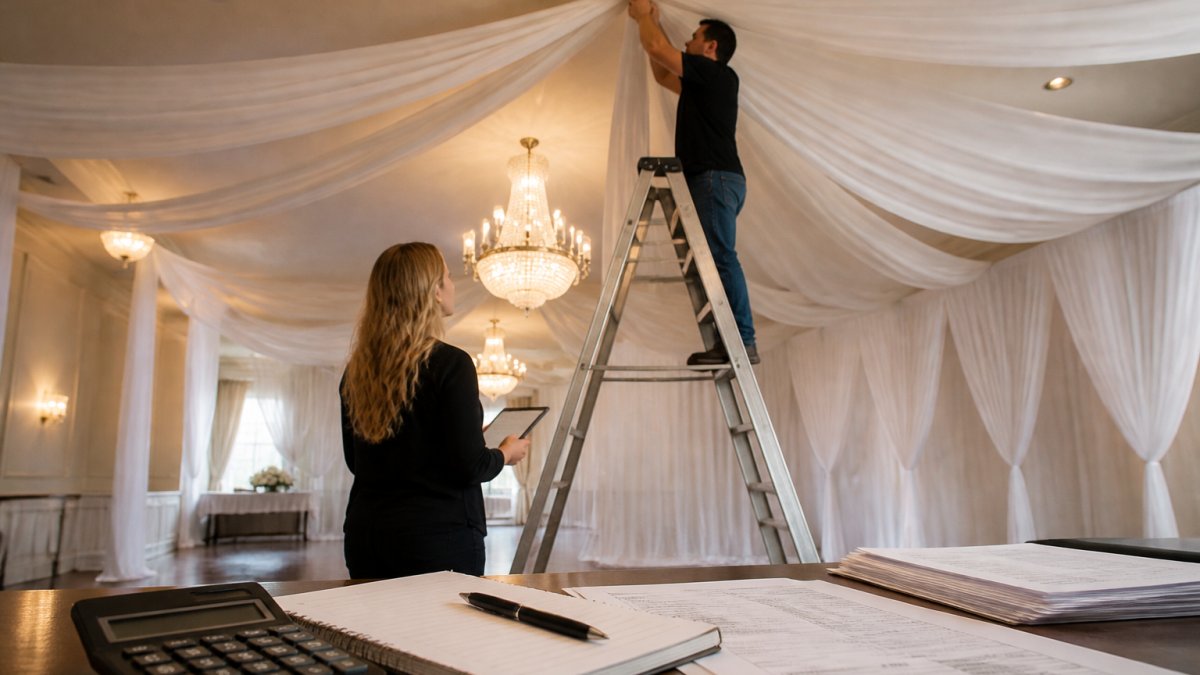
Across Southern California venues, the fabric is rarely the expensive part. Access is. Height is. The number of installers required to finish before your guests arrive is.
According to CV Linens' 2026 event draping pricing overview, basic backdrop or wall draping typically runs $300 to $1,000, while ceiling or full-room installations commonly land between $1,000 and $5,000 or more.
The Four Line Items Behind Every Draping Quote
Professional draping estimates generally break into the same four categories. Ask any vendor to separate them, and you will immediately see where a cheap quote is hiding its real cost.
| Line Item | What It Covers | Why It Varies |
|---|---|---|
| Fabric and materials | Panels, liners, sheer overlay, hardware | Yardage, fabric type, fullness ratio |
| Labor and installation | Installer hours, rigging, climbing | Ceiling height, complexity, crew size |
| Equipment | Lifts, truss, motors, pipe and drape kits | Whether the venue supplies rigging points |
| Logistics | Delivery, setup window, teardown, cleaning | Distance, venue access, load-in rules |
A quote that lists one lump sum tells you nothing. A quote that separates these four tells you what you can cut without wrecking the design.
2026 Price Ranges by Project Size and Service Level
Project size drives price more than any other variable. A single backdrop and a full ballroom transformation use the same fabric and crew, but not the same quantity of either.
| Project Scope | Typical 2026 Range | What Drives It |
|---|---|---|
| Single backdrop or accent wall | $300 - $1,000 | Panel count, fabric choice |
| Pipe and drape partition or entry | From about $50 per 10x10 kit | Kit quantity, hardware grade |
| Reception wall and entry draping | $1,000 - $3,000 | Linear footage, finish details |
| Full ballroom ceiling and walls | $2,000 - $5,000 | Square footage, ceiling height |
| Complex ceiling with greenery and lighting | $8,000 - $12,000+ | Rigging, labor hours, design complexity |
Those upper figures are not marketing inflation.
For context on the whole budget: The Knot's 2026 Real Weddings Study puts the average total wedding cost at $34,200, with the reception venue alone averaging $12,900.
How the Line Items Combine Into a Final Estimate
Most published ranges stop at a single number. The more useful exercise is seeing how the four line items stack into a final estimate, because that is the document you will actually compare against other vendors.
| Line Item | What It Represents | How It Scales |
|---|---|---|
| Fabric and materials | Panels, liners, sheer overlay, hardware | Yardage × fullness ratio × fabric grade |
| Labor and installation | Installer hours, rigging, climbing | Crew size × hours × ceiling height |
| Equipment | Lifts, truss, motors, pipe and drape kits | Whether the venue supplies rigging points |
| Logistics | Delivery, setup window, teardown, cleaning | Distance, venue access, load-in rules |
| Taxes and fees | Sales tax, venue COI or certificate fees | Jurisdiction and venue policy |
A worked example makes the mechanism concrete.
The EXTERNAL_LINK: 2026 event lighting and decor pricing guide from XL Entertainment Systems shows how lighting and decor costs stack alongside draping, which helps when you are building one combined budget instead of two separate ones.
Service Level Changes the Number, Not Just the Fabric
Two couples can request the same 30-foot wall and receive very different estimates because they are buying different service levels. Some arrangements assume you install and strike the draping yourself, while others move labor and equipment onto the vendor, and fuller service adds site planning, rigging, and a crew that finishes before guests arrive.
That is also why the cheapest line on a quote is rarely the cheapest outcome. Ask every vendor which service level their number reflects before comparing totals.
What Moves Your Estimate Up or Down
Four levers account for most of the variation between a modest estimate and a premium one:
- Ceiling height and access. Higher ceilings and narrow load-in paths require lifts, more crew, and longer setup windows.
- Fullness ratio and fabric grade. A 1.5x gather on a quality fabric can read as fuller than 3x on a thin one, and it uses less yardage.
- Venue rules. Rigging restrictions, fire-rated fabric requirements, and same-night strike deadlines all add labor or equipment.
None of these levers is hidden. A vendor who itemizes them gives you a document you can negotiate against; a vendor who does not is asking you to trust a lump sum.
How to Size Your Wedding Ceiling Draping Cost Before You Call
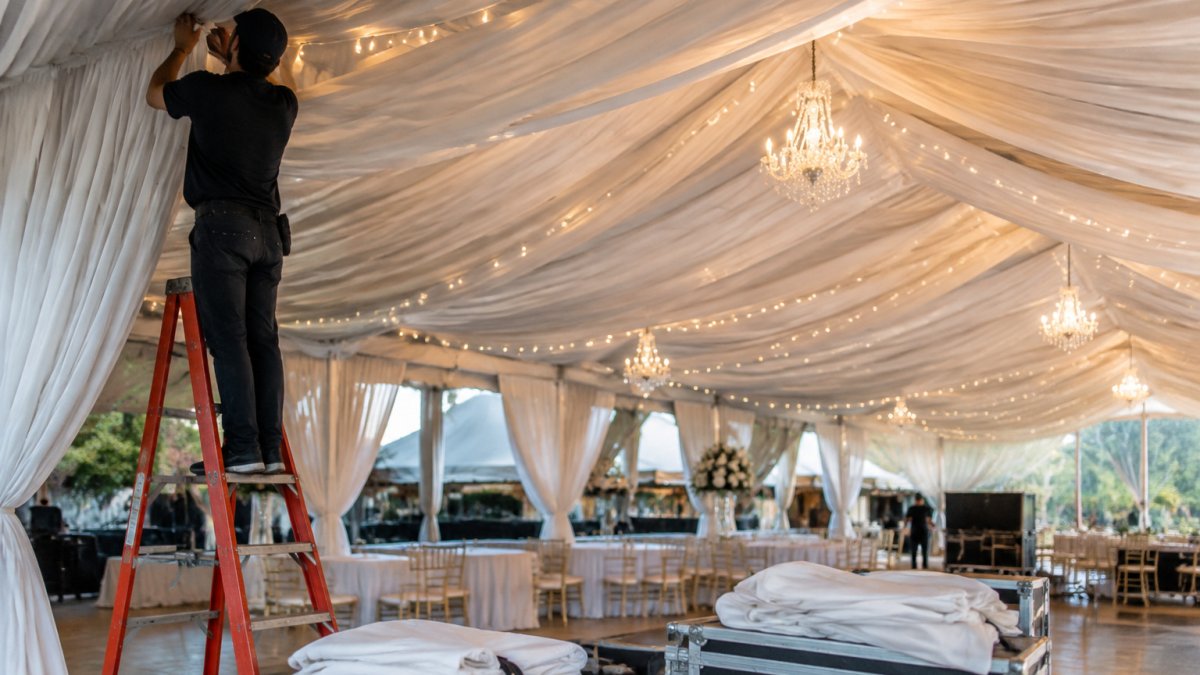
Wedding ceiling draping cost scales with square footage and height, not with how dramatic the finished result looks. A low, wide ballroom ceiling can cost less to drape than a narrow room with a 20-foot ceiling, because the second needs lifts, rigging, and more installer hours.
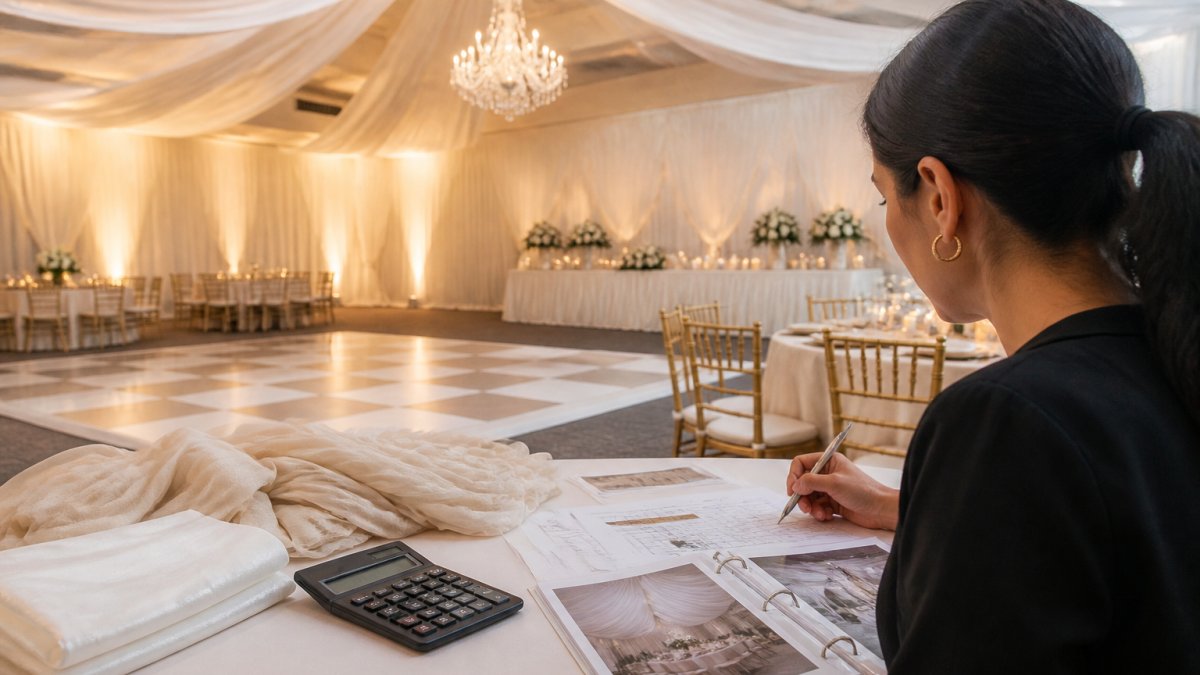
You can estimate your own scope in about ten minutes with a tape measure and the venue's floor plan.
A Simple Measurement Worksheet and Estimating Formula
Work through these fields before you request pricing. Vendors quote faster and more accurately when you bring numbers instead of adjectives.
- Finished width: the linear feet of wall or ceiling span you want covered
- Finished height: floor to ceiling, or floor to the top of your backdrop
- Coverage area: finished width multiplied by finished height
The estimating formula: total yardage = (finished width × fullness ratio) ÷ roll width.
That math is why a "simple" 30-foot backdrop can consume more fabric than a couple expects, and why a heavier fabric at 1.5x fullness can look fuller than a thin one at 2x.
Wedding Draping Installation Requirements That Change the Price
Installation requirements are the single most underestimated cost factor in wedding draping. Fabric is predictable. Venues are not.
A wedding planning community thread on hidden draping costs makes the point plainly: draping costs are driven less by fabric than by venue accessibility, the need for specialized equipment like lifts, and the labor required for complex ceiling work. A venue with no rigging points and a 22-foot ceiling can double the labor line on an otherwise identical design.
The practical constraints we plan around, and the ones that most often change a quote after the first walkthrough:
Ceiling Attachment and Rigging Limits
Not every ceiling accepts draping. Ballrooms with exposed truss, engineered rigging points, or a designated track system can carry fabric directly. Rooms with finished drywall, acoustic tile, or decorative plaster usually cannot, and the design has to shift to freestanding frames, pipe and drape, or a perimeter track, which requires more hardware, floor space, and labor hours.
Ask the venue for its written rigging policy before you approve a ceiling design. The answer determines whether your estimate includes motors, truss, and a rigging crew or a simpler frame-based install.
Fire-Rated Fabric and Venue Safety Rules
Most venues enforce flame-resistance requirements on any fabric brought into the room, and many require documentation from the vendor. Fabric that is not rated, or that arrives without the right paperwork, can be refused at load-in.
Egress rules matter just as much. Draping cannot block exit paths, fire extinguishers, or sprinkler coverage, and a design that looks elegant on a floor plan can fail an egress review if it narrows a required aisle.
Load-In, Setup Windows, and Teardown Deadlines
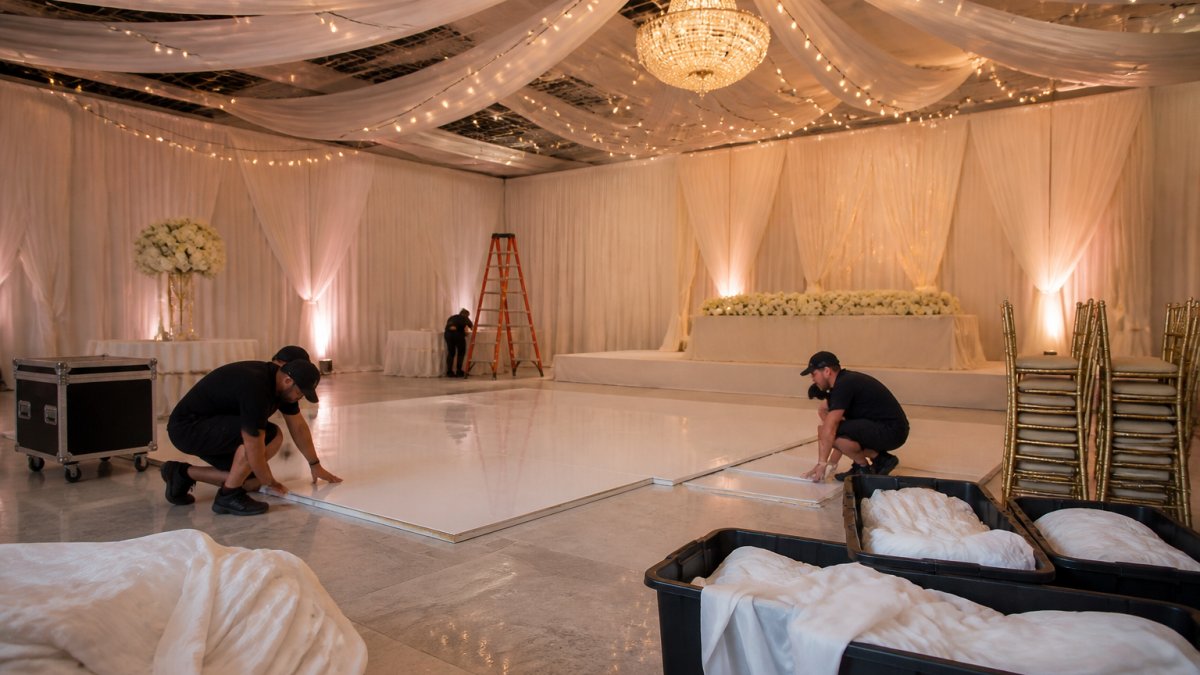
Many venues allow setup only in a narrow window, which means more crew members working simultaneously to finish on time. A four-hour window and a ten-hour window can produce very different labor lines for the same design.
Access is the other half of the equation. Loading docks, freight elevators, stair widths, and door heights determine what equipment can reach the room at all.
Wall Surfaces and Anchoring
Exposed brick, glass, and historic plaster often require freestanding frames instead of anchors. Ask what the walls are made of and what the venue allows before you fall in love with a wall-draping design.
Venue Approval and Certificates of Insurance
Many venues require vendors to submit a certificate of insurance and be approved before load-in. Some require the vendor to be on an approved list, and some charge a fee for outside vendors. A family-owned rental company that installs regularly in your venue will usually already have the paperwork on file.
If your space is unusually large or architecturally awkward, our guide to draping large event spaces from layout to install walks through the planning sequence in more detail.
How These Constraints Show Up in Your Estimate
Each constraint above maps to a line item: rigging limits to equipment, fire-rating and egress rules to fabric selection and design time, load-in windows and teardown deadlines to labor hours, wall surfaces to hardware, and venue approval to administrative fees. A vendor who walks your room and asks about all five is building an estimate you can trust.
Affordable Wedding Draping Ideas That Still Look Expensive
Budget draping fails when it tries to cover everything. It succeeds when it concentrates fabric where the eye lands: the ceremony focal point, the sweetheart table, the entry.
A single well-executed backdrop behind your ceremony reads as a design decision. Ten feet of half-hearted draping along a side wall reads as an afterthought.
Four approaches that can deliver high visual impact per dollar:
- Concentrate on one wall. A full-height backdrop behind the ceremony or head table does more than partial coverage spread across the room.
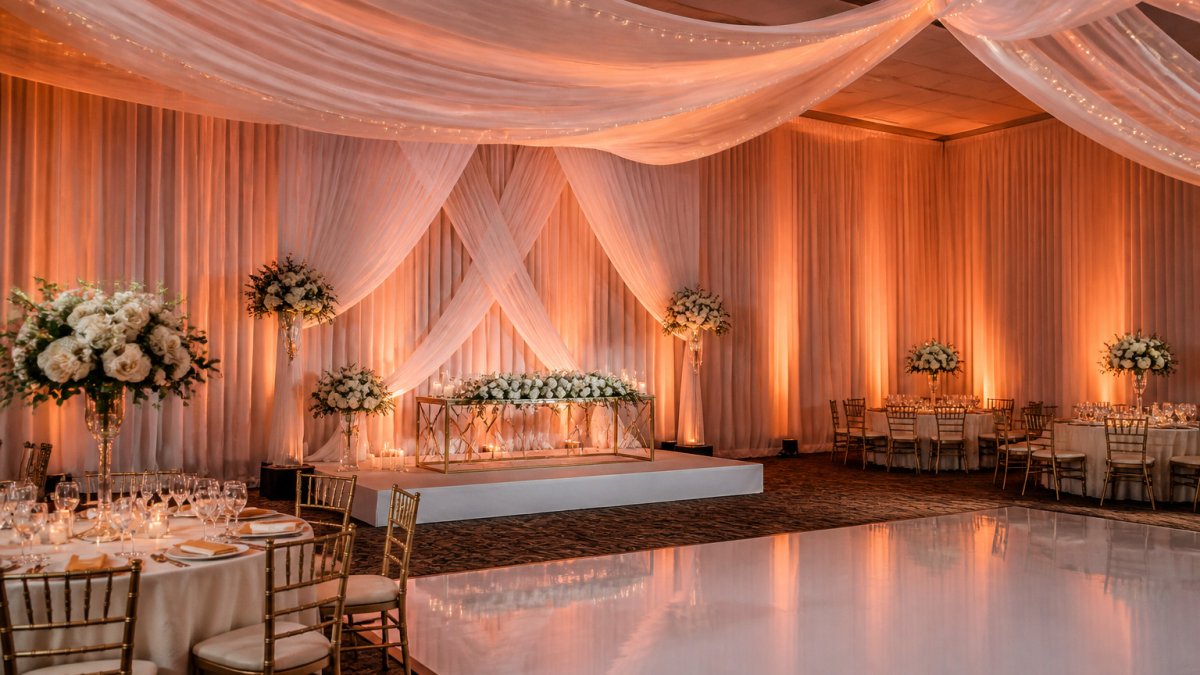
- Pair draping with uplighting. Lighting changes how fabric reads at night, and warm amber washes make inexpensive sheers look considerably richer.
- Use pipe and drape for structure. Freestanding pipe and drape creates defined entries and partitions without permanent installation costs.
For more low-cost options that pair well with draping in larger rooms, see our collection of affordable wedding decor ideas for large venues.
Your Wedding Draping Quote Checklist: 9 Questions to Ask
A wedding draping quote checklist turns a vague estimate into a comparable document. Ask every vendor the same nine questions, and the differences become obvious.
- Does the quote itemize fabric, labor, equipment, and logistics separately?
- Is the finished width and finished height stated in feet, not described in words?
- What fullness ratio is being quoted, and what does it look like installed?
That last question matters more than couples expect. Change deadlines determine whether you can adjust your design after a venue walkthrough.
The EXTERNAL_LINK: 2026 lighting and draping planning guide from XL Entertainment Systems covers how to sequence draping decisions alongside lighting choices, which is the order that keeps both budgets honest.
Request a Free Draping and Lighting Quote for Your Venue
The most accurate wedding venue draping cost estimates in 2026 come from a walkthrough, not a calculator.
XL Entertainment Systems is a family-owned wedding and event rental company established in 1992, serving Orange County, Los Angeles, Riverside, and San Bernardino counties.
You can explore our wedding draping, lighting, dance floor, and chair rental services to see what fits your venue, or send us your details for a free custom quote.
Frequently Asked Questions
How much does wedding venue draping cost in 2026?
Draping costs depend on measurements, fabric, ceiling height, and labor, so request an itemized quote for your venue.
Is ceiling draping more expensive than wall draping?
Usually yes. Wall draping covers a flat vertical plane that crews can reach from the floor. Ceiling work adds height, rigging points, lifts or scaffolding, and more fabric per square foot of coverage. Ask for the ceiling portion of your wedding ceiling draping cost to be itemized separately so you can compare it against wall-only options.
How much draping do I need for my wedding venue?
Measure the finished width and finished height of each surface you want covered, then add 50 to 100 percent extra fabric for fullness. A 20-foot wall at 10 feet high is 200 square feet of coverage, but a 75 percent fullness ratio means roughly 350 square feet of fabric. Repeat this for every wall, doorway, and ceiling panel, then total the yardage. Bring those numbers to your quote call so the estimate reflects your actual venue instead of a rough guess.
Can I reduce wedding draping costs without losing the look?
Focus draping on the surfaces guests photograph most: the ceremony backdrop, sweetheart table, and one statement ceiling panel. Choose a simpler top and bottom finish, skip specialty fabrics where a standard sheer reads the same under uplighting, and bundle draping with lighting or a dance floor so delivery and labor are shared across services. These affordable wedding draping ideas cut square footage and setup time without flattening the design, and a written quote checklist keeps the comparison honest.
Your venue has constraints, and your budget has a ceiling. The right draping plan works inside both instead of pretending neither exists. Get started with XL Entertainment Systems and request a free, itemized quote built around your actual room, your date, and the look you have been picturing.