 how-to
Is Ceiling Draping Worth It for Orange County Events?
Last Updated: November 7, 2026
Quick Summary
Ceiling draping is worth it in many Orange County event spaces when the design, venue rules and timeline line up. Fabric overhead softens hard ceilings, hides trusses and systems, and makes a ballroom feel intimate. Confirm venue attachment rules and allow four to eight weeks for planning before booking.
- Confirm venue rules on attachment points, drilling and fabric flame-resistance before finalizing any design.
- Get venue approval for ceiling installation in writing, not as a verbal assurance.
- Start site measurements four to eight weeks before the event to record ceiling height and obstructions.
- Pair drape color and fullness first, then choose lighting that complements the fabric.
- If the venue restricts ceiling attachment, freestanding frames or perimeter treatments can achieve a similar look.
Table of Contents
- How Ceiling Draping Changes a Room
- Indoor Ceiling Draping Options for Ballrooms and Event Halls
- Ceiling Draping with Lighting: Combining Fabric and Light
- Pipe and Drape Rental as the Base for Ceiling Designs
- Checking Whether Your Venue Allows Ceiling Installation
- Planning Timeline, Setup, and Teardown
- Wedding Drapery Rentals and Your Next Booking Step
- Frequently Asked Questions
Ceiling draping can change a room more than almost any other single decision in event design. At Wedding Draping, Lighting, Dance Floors & Chair Rentals, our family has been in this business since 1992, helping couples and planners in Southern California decide whether a ceiling transformation fits their event. The question we hear most often is simple: will the room look better, and is it practical for our venue? The honest answer is that ceiling draping is worth it in many Orange County settings, but only when the design, the venue rules and the timeline line up.
How Ceiling Draping Changes a Room
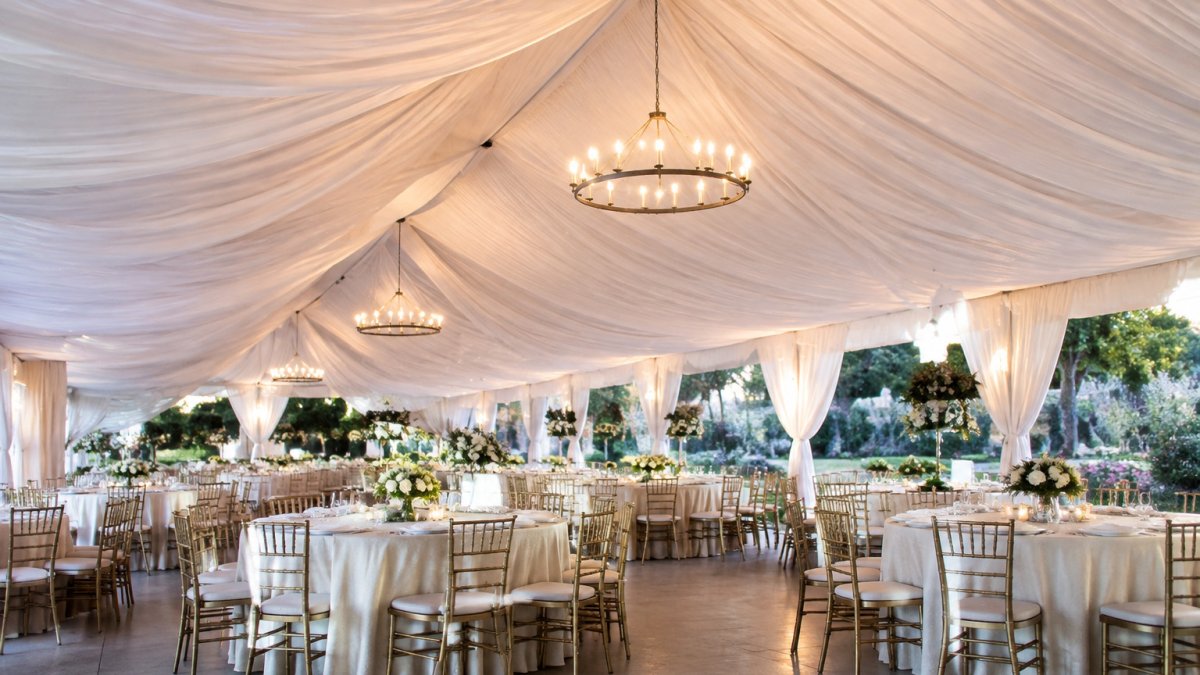
Fabric overhead does something a centerpiece cannot. It softens hard ceilings, hides exposed trusses and mechanical systems, and draws the eye upward so a ballroom feels intimate instead of cavernous. Wedding draping has seen renewed interest in recent years. Trends matter less than function, though. The real value is that a draped ceiling gives the whole room a single, cohesive look that guests notice the moment they walk in.
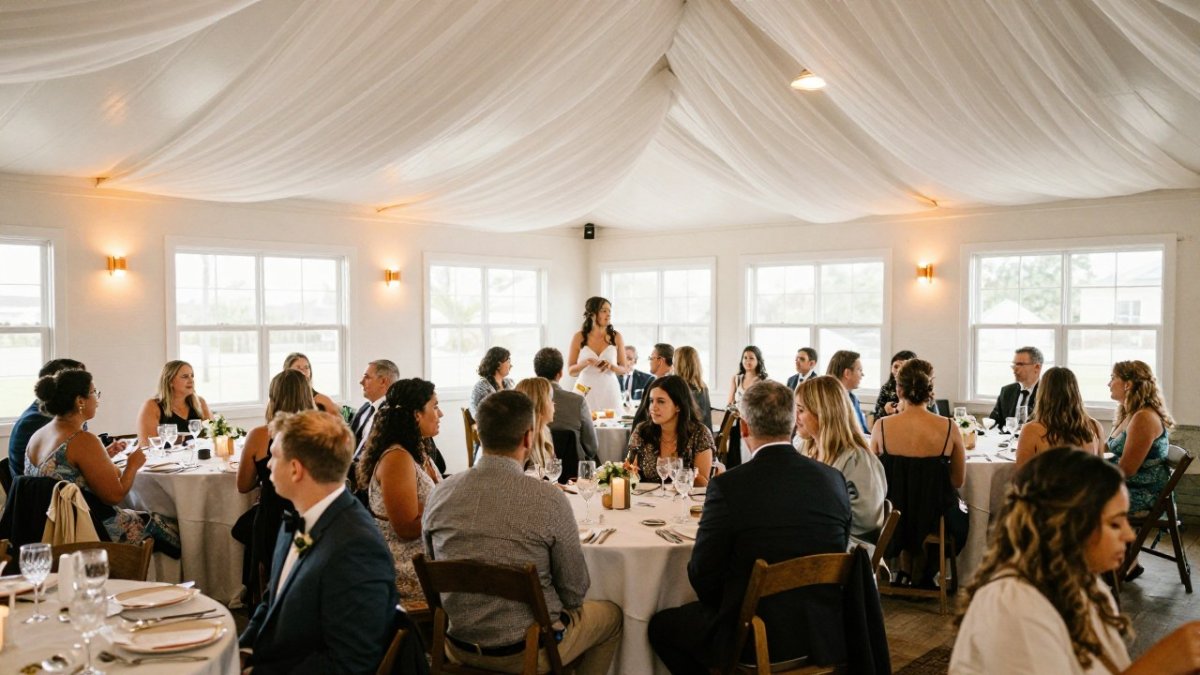
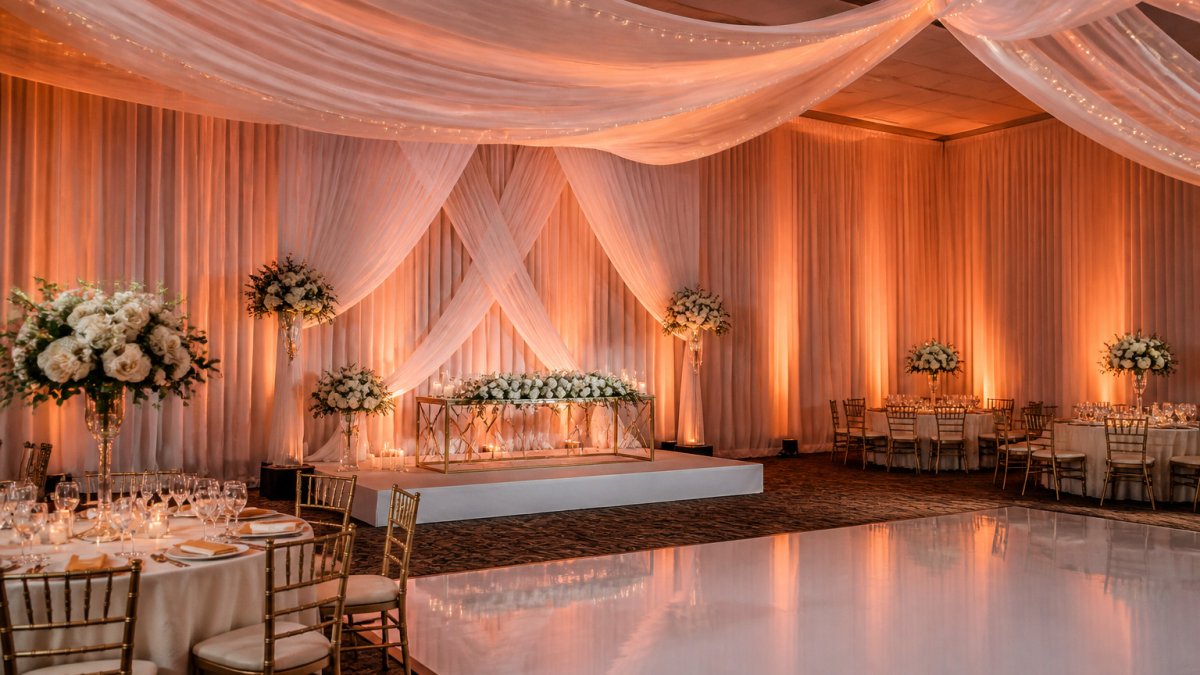
Picture a bright ballroom in Orange County with white ceiling swags, warm amber uplighting and guests seated at round tables during the reception. The fabric catches the light, the room feels warmer, and the space reads as designed rather than merely rented.
Indoor Ceiling Draping Options for Ballrooms and Event Halls
Indoor ceiling draping comes in several forms, and the right one depends on the ceiling height, the room shape and the look you want. Swags drape in long, loose curves across the ceiling and suit large, open halls. Full-fabric wraps cover more of the ceiling and work well for smaller rooms where you want a complete enclosure. Ceiling treatments can also run along the perimeter, leaving the center open for a chandelier or a focal lighting feature.
Fabric choice affects the result as much as the layout. Light, sheer materials glow when uplit, while heavier fabrics give a more formal, structured look. We recommend testing color under the room's actual lighting, since a shade that looks crisp in daylight can read very differently under evening light.
Ceiling Draping with Lighting: Combining Fabric and Light
Draping and lighting work best as a pair. Fabric alone can look flat after dark, and lighting alone can leave a ceiling looking bare. Uplighting the drape from below turns the fabric into a soft, glowing canopy, while string or bistro lights threaded through the swags add a layer of warmth at eye level. See how draping and lighting pairings work for weddings in our planning guide.
A common mistake is choosing lights before settling the fabric. Start with the drape color and fullness, then select a lighting temperature and color that complements it. Amber tones tend to feel romantic in a wedding setting, while cooler whites suit corporate galas and product launches. Keep the number of light colors small, since too many hues can make a room look busy.
Pipe and Drape Rental as the Base for Ceiling Designs
Most ceiling and wall treatments rest on a pipe-and-drape framework. The pipe system provides the structure that holds fabric in place, and it is often the first thing a planner should understand before committing to a design. Pipe-and-drape rental is the foundation for many event setups, from backdrops to full room enclosures. Explore the draping and related rental options we offer for Orange County and Southern California events.
Ask your installer how the frame will be anchored and how much clearance it needs. The frame determines the maximum drape weight, the spacing of the swags and whether the design can clear existing fixtures, so it deserves attention early in the planning process.
Checking Whether Your Venue Allows Ceiling Installation
Before you fall in love with a design, confirm that the venue allows it. This is the step most planners skip, and it is the one that most often forces a redesign two weeks before the event. Venue rules can restrict ceiling installation, and some facilities prohibit drilling into ceilings or require specific clearances. Venue rules can prohibit ceiling drilling and may require covered bases and visible exit signs, so the design approach should be confirmed with the venue ahead of time.
Treat the venue conversation as a structured checklist rather than a casual phone call. Ask, and get answers in writing, on each of the following:
- Attachment points. Which structural members may fabric be tied to, and which are off-limits? Many venues allow suspension only from designated beams, ceiling grids rated for it, or existing rigging points, and forbid anything attached to fire sprinkler lines, HVAC ductwork, or acoustic ceiling tile.
- Drilling and hardware. Is drilling, screwing, or adhesive mounting permitted at all? If not, the design must rely on freestanding pipe-and-drape frames, tensioned cable systems, or weighted bases.
- Fire safety for fabric. Venues often require drapery and fabric used in assembly spaces to meet a flame-resistance standard, and many will ask for documentation before install day. Confirm what the venue requires and whether the fabric you are renting carries that documentation.
- Sprinkler clearance and coverage. Nothing may obstruct sprinkler heads or hang close enough to interfere with spray patterns. Confirm the required clearance below heads and around the coverage area.
- Exit signs, egress paths, and fire lanes. Exit signage must stay visible and illuminated, and draped fabric cannot narrow or block egress routes. Some venues require covered bases and unobstructed exit signs, which affects where frames can stand.
- Load limits and hang points. Ask whether the venue publishes a per-point load limit and how many usable points exist. The frame and fabric weight must stay within those limits.
- Setup and strike windows. Confirm the earliest load-in time, the latest strike time, dock and elevator access, and whether other vendors share the room during your window.
- Insurance and vendor approval. Many venues require a certificate of insurance from the installer and pre-approval of the vendor before load-in.
Watch out: a verbal "that should be fine" from a venue coordinator is not approval. Get the sign-off in writing and keep it with the design drawings, because the person working the event may not be the person who gave the answer.
A design that cannot be installed as drawn wastes time and money, so this check is worth doing first. If the venue restricts ceiling attachment, the same draped look can often be achieved with freestanding pipe-and-drape frames, perimeter treatments, or a suspended backdrop behind the sweetheart table, so ask your installer which alternatives fit the room before abandoning the concept.
Planning Timeline, Setup, and Teardown
Ceiling draping takes longer to install than most people expect, so build the timeline backward from your event date. The sequence below reflects how professional installs typically run, and the durations are planning ranges rather than guarantees, since ceiling height, coverage, and venue access change everything.
Step 1: Site visit and measurements (four to eight weeks out). Walk the room with the installer and record ceiling height at the highest and lowest points, room length and width, the location of beams, trusses, sprinkler heads, exit signs, chandeliers, and HVAC vents, and the sightlines from the entrance and the head table. A simple measurement checklist keeps this consistent: ceiling height, usable attachment points, obstructions, dock and elevator dimensions, door widths, and power outlet locations. Room dimensions, ceiling features, and obstructions shape the design far more than a photo does.
Step 2: Design approval and venue sign-off (three to six weeks out). Finalize fabric, color, fullness, swag spacing, and lighting plan, then submit the design to the venue for approval along with any required insurance and flame-resistance documentation. Build in a buffer here, because venue approvals can take days to weeks depending on the facility.
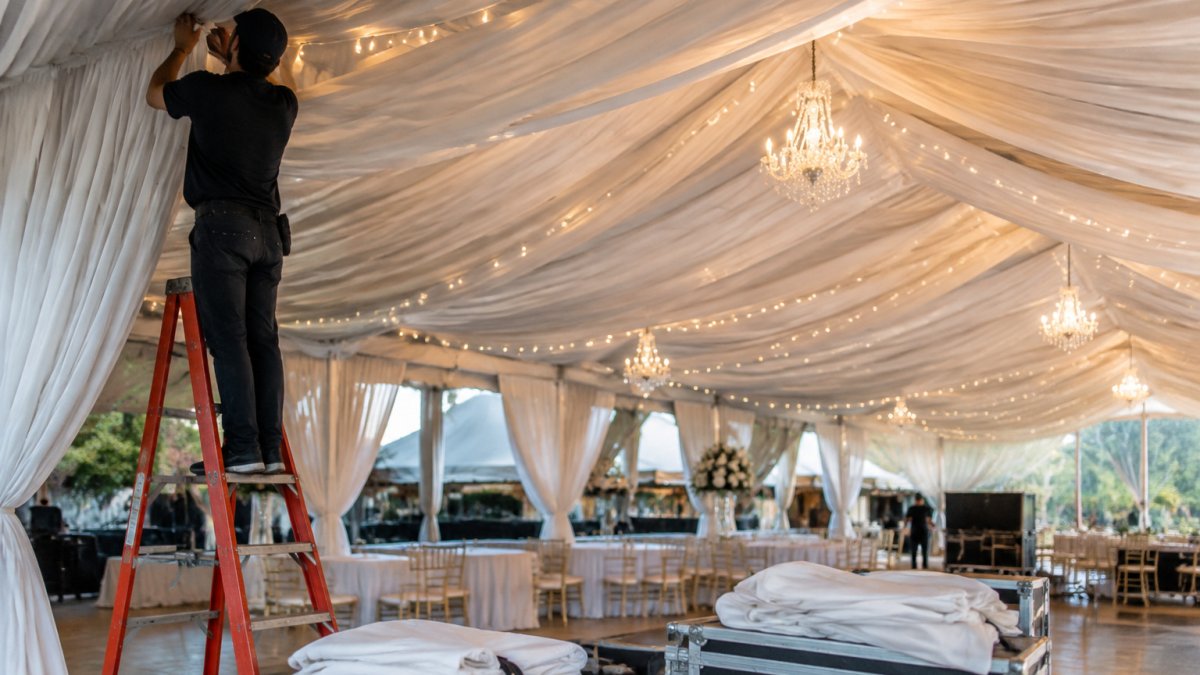
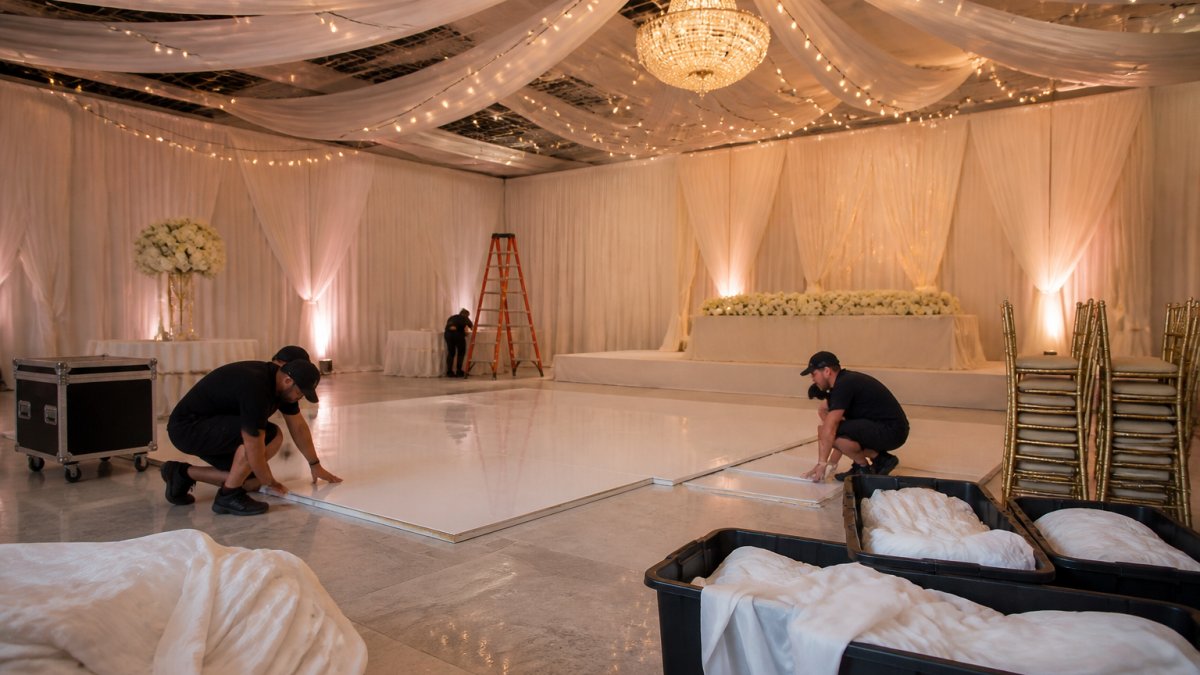
Step 3: Delivery and load-in (day before or morning of). Confirm dock hours, elevator availability, and whether the crew can work while other vendors set up. Installation done during a quiet window tends to go more smoothly than work squeezed between other vendors. Learn how to lay out and install large draped spaces step by step. A full ceiling treatment can take several hours depending on coverage, so avoid scheduling it into a short gap.
Step 4: Frame, fabric, and lighting focus. Frames go up first, then fabric is hung and dressed, then lighting is focused against the finished drape. Focusing lights before the fabric is in place usually means refocusing later.
Step 5: Final inspection before guests arrive. Check that fabric is secure, exit signs and sprinklers are clear, no frame blocks egress, and the lighting reads the way it did in the design.
Step 6: Teardown and removal. Teardown needs its own window, especially if the venue has a tight turnover schedule. Confirm the latest strike time, whether the crew can return the next morning, and who is responsible for removing hardware and fabric. Fabric that is folded and packed properly lasts longer and avoids wrinkles on the next install.
Watch out: the most common timeline failure is treating installation as a same-day task squeezed between the florist and the caterer. If the venue only offers a short setup window, ask your installer whether a partial ceiling treatment or a freestanding alternative can deliver the look within the time available.
The article breaks installation into a sequence of steps, each with its own timing window.
| Step | What to do | Timing |
|---|---|---|
| Site visit and measurements | Record ceiling height, attachment points, obstructions and sightlines | Four to eight weeks out |
| Design approval and venue sign-off | Finalize fabric, color and lighting, then submit for approval | Three to six weeks out |
| Delivery and load-in | Confirm dock hours and elevator access, then install | Day before or morning of |
| Frame, fabric and lighting focus | Hang frames, dress fabric, then focus lights | During installation |
| Final inspection | Check fabric security, exit signs, sprinklers and lighting | Before guests arrive |
| Teardown and removal | Confirm strike time and pack fabric properly | After the event |
Wedding Drapery Rentals and Your Next Booking Step
If you are weighing ceiling draping for an Orange County event, start by sharing your event date, venue, location and the services you have in mind. We can help you think through which combination of draping, lighting, dance floors and chair rentals fits your room and budget. Contact XL Entertainment Systems to request a free, personalized quote, and browse our wedding and event gallery to see how draped spaces have looked in real rooms.
Frequently Asked Questions
How much does it cost to drape a ceiling?
Cost depends on the size of the room, the fabric and drape style chosen, how many lighting elements you add, the delivery distance, and the installation schedule. Because every event differs, XL Entertainment Systems prices each project individually after reviewing your date, venue, and requested services. Share those details through our quote request form and the team will provide a personalized estimate with no obligation.
How do you drape a ceiling?
Ceiling draping typically starts with a rigging or pipe-and-drape framework that supports fabric panels, swags, or full-fabric wraps. Installers measure the room, plan the fabric layout around existing features, and then hang the materials in stages. Teams verify attachment points, check sightlines, and adjust the drape height before the room is handed over. Venue rules on ceiling attachment should be confirmed before the design is finalized.
Can ceiling draping be combined with event lighting?
Yes. Many couples and planners pair ceiling draping with uplighting, string lights, or market lights to add warmth and depth. Lighting placed along the drape folds can highlight texture, while uplighting on walls or columns balances the room. Planning the fabric and lighting together helps avoid hot spots and ensures the design reads well from the dance floor and dining areas.
How do I know whether a venue can accommodate ceiling draping?
Start by asking the venue for its rules on ceiling attachment, rigging, and load-bearing structures. Some venues prohibit drilling into ceilings or require covered bases and visible exit signs, so the installation approach may change. Share the venue layout, ceiling height, and event date with your rental provider so they can review options before you commit.