 how-to
Professional Event Setup and Teardown: 2026 Guide
Table of Contents
- Professional Event Setup and Teardown: What the Job Really Involves
- What You'll Need Before Setup Day
- Step 1: Build Your Event Setup and Teardown Checklist
- Step 2: Create an Event Setup and Teardown Schedule
- Step 3: Choose the Right Event Setup Services for Your Venue
- Step 4: Handle Wedding Event Setup and Teardown with Care
- Step 5: Manage Teardown, Staffing, and Vendor Coordination
- Common Mistakes to Avoid During Setup and Teardown
- Frequently Asked Questions
Last Updated: October 8, 2026
Professional Event Setup and Teardown: What the Job Really Involves
Professional event setup and teardown is the work of turning an empty venue into a finished event space, then returning it to bare walls once the last guest leaves. At XL Entertainment Systems, we've handled that work for over 30 years, and we can tell you it rarely looks like the calm timeline on paper.
The job runs on three clocks:
- The venue clock. Your load-in window is fixed. Miss it and you lose the day.
- The vendor clock. Rentals, catering, and entertainment all want the same dock at the same time.
- The guest clock. Doors open at a set hour, no matter what went wrong at noon.
Most guides treat setup as a list of tasks. It's really a scheduling problem. The teams that finish on time aren't working harder. They built their plan backward from doors open, and they left room for the surprises that always show up.
Below, we'll walk through the exact steps we use: the checklist, the schedule, choosing setup services, handling weddings with care, and running teardown without burning out your crew.
What You'll Need Before Setup Day
Before setup day, you need three things locked down: venue access, a tool kit, and a load-in plan. Everything else can flex.
Venue Access and Load-In Windows
Every venue has rules about when you can get in and how you get in. Some give you the whole day. Others hand you a two-hour window between other bookings.
Ask these questions before you sign anything:
- What time does the loading dock open, and is it shared?
- Is there a freight elevator, and does it need an operator?
- Where can trucks park, and for how long?
- Does the venue require a certificate of insurance from your vendor?
Get the answers in writing. A verbal "sure, come early" means nothing when a venue manager changes shifts.
Tools and Supplies for a Smooth Teardown
A good teardown kit saves you a second trip and a lot of arguing. Pack it before setup day, not after.
- Gaff tape and painter's tape
- Cable ramps and zip ties
- Work gloves and knee pads
- Box cutters and a multi-tool
- Trash bags and a broom
- A labeled bin for every vendor's gear
Labeling matters more than people think. When three vendors all own black cable, labels are the only thing that keeps teardown from turning into a fight.
Step 1: Build Your Event Setup and Teardown Checklist
An event setup and teardown checklist is a single document that lists every item going in, who owns it, and when it comes out. One list, not five.
Build it in four columns:
| Column | What Goes In It |
|---|---|
| Item | Drape, staging, chairs, lighting, dance floor |
| Owner | Your team, venue, or a rental vendor |
| Setup time | When it goes in |
| Teardown time | When it comes out |
The teardown column is the one most people skip. That's the mistake. If you don't know who removes the staging, you'll be the one doing it at 1 a.m.
Walk the venue once with the checklist in hand. Mark every power outlet, every door, and every obstacle. Then update the list before you send it to anyone.
Step 2: Create an Event Setup and Teardown Schedule
An event setup and teardown schedule is a timeline that works backward from doors open and forward through load-out. It assigns a start and end time to every task.
Working Backward from Doors Open
Start with the moment guests arrive. Then subtract.
- Final walkthrough and lighting check: 1 hour before
- Table settings and centerpieces: 2 hours before
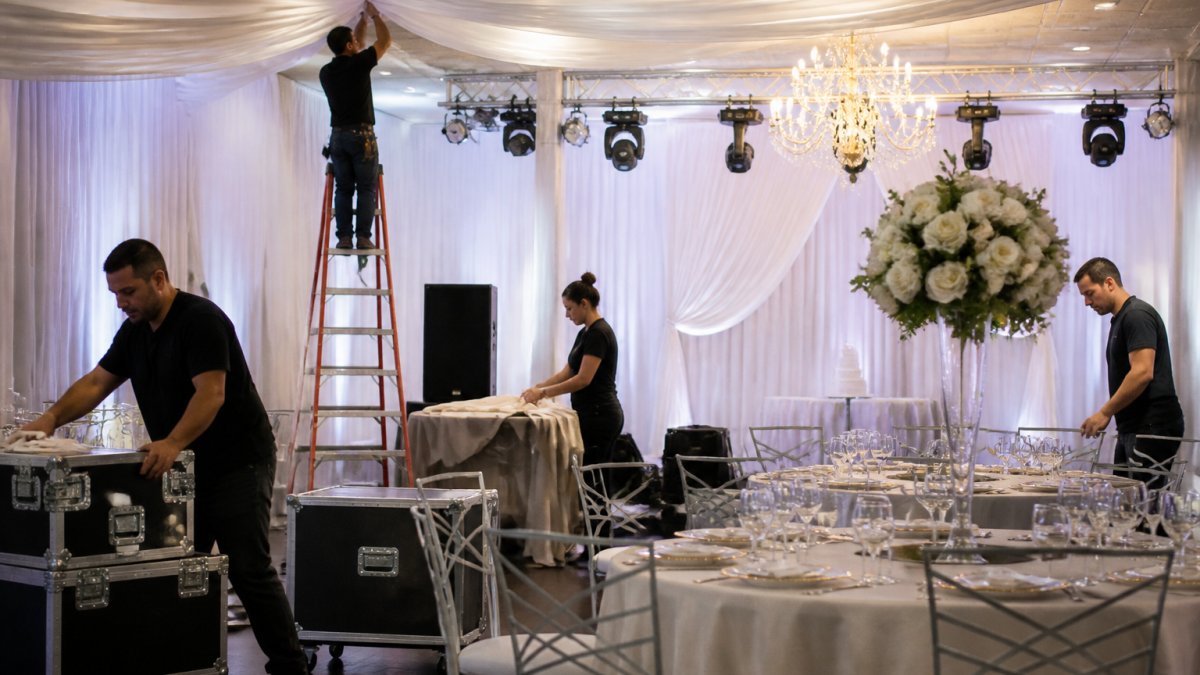
- Draping and staging: 3 to 4 hours before
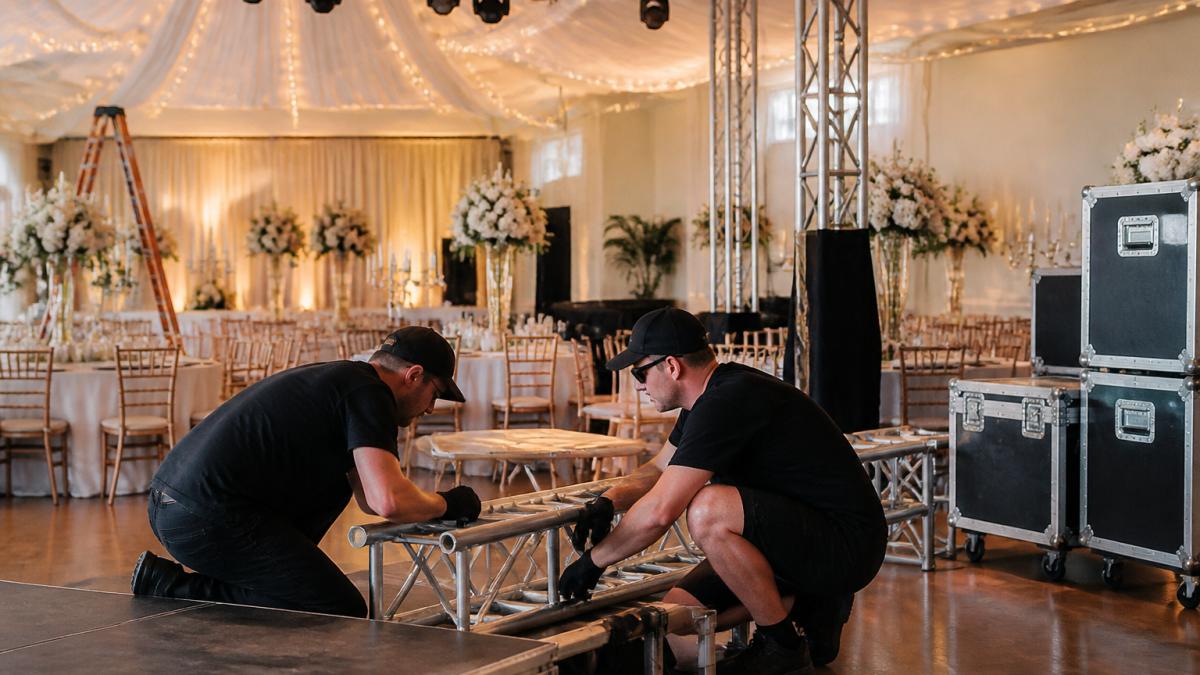
- Lighting rig and cable runs: first, since they sit behind everything else
Heavy items go in first. Drape and lighting come before tables, because you can't hang pipe and drape over a set table.
Building in Buffer Time for Surprises
Buffer time is not padding. It's the part of the schedule that absorbs reality.
Add 15 to 20 percent more time than your best-case estimate. If setup should take four hours, plan for five. Late rentals, a locked door, or a missing power drop will eat that hour. Without buffer, they eat your event.
Step 3: Choose the Right Event Setup Services for Your Venue
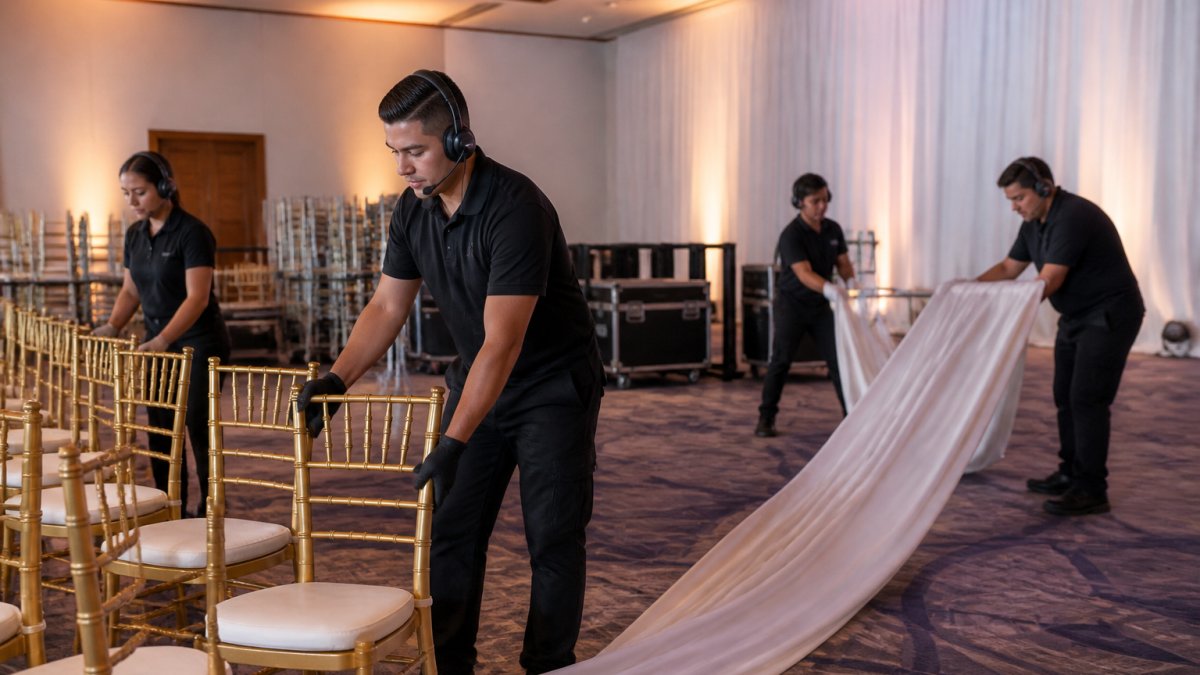
The right event setup services match your venue's limits: its access, its power, and its rules. A vendor who knows your space will plan around those limits before setup day.
When you compare vendors, ask about:
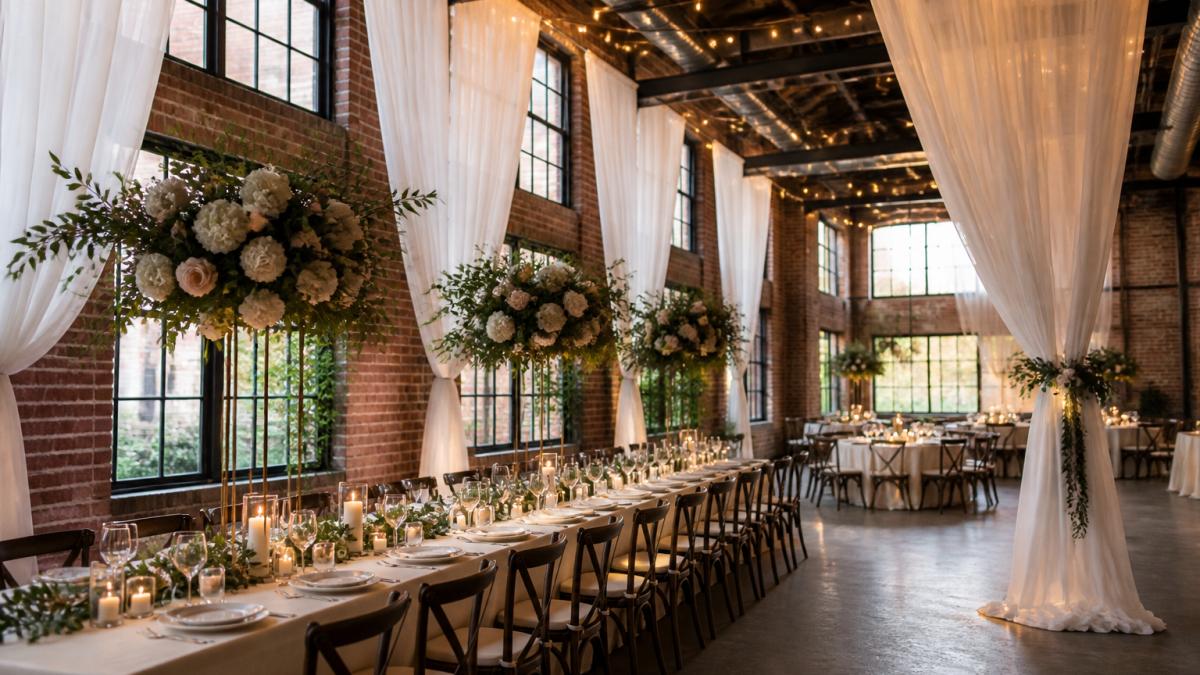
- Experience with your venue type. A loft with exposed brick needs different rigging than a hotel ballroom.
- Scope. Do they handle lighting, draping, staging, and teardown, or just one piece?
- Insurance and permits. Ask to see their certificate of insurance.
- References. Ask for two events similar to yours, and actually call them.
This is where a single full-service partner beats five separate vendors. One team that owns lighting, draping, staging, and teardown removes the coordination problem entirely. XL Entertainment Systems handles all of it in-house, which means one schedule, one point of contact, and one crew that knows the whole room.
Step 4: Handle Wedding Event Setup and Teardown with Care
Wedding event setup and teardown needs a gentler plan than a corporate job. The room has to feel personal, and it has to come down without damaging rented or borrowed pieces.
Three rules guide our wedding work:
- Protect the sentimental items. Family photos and heirlooms get handled by one named person, not the whole crew.
- Photograph everything. Before and after photos protect you and the venue.
- Give the couple a quiet exit. Tear down the main room only after guests move to the after-party space.
Timing matters too. Most couples want the ceremony space flipped to a reception during cocktail hour. That flip is a setup job inside a teardown window, and it needs its own mini-schedule.
Step 5: Manage Teardown, Staffing, and Vendor Coordination
Teardown, staffing, and vendor coordination decide whether you finish at midnight or 3 a.m. Treat load-out as a scheduled event with its own start time.
A simple teardown order keeps the crew moving:
- Clear guests and secure the room.
- Collect all rented items in one staging area.
- Break down lighting and drape last, since they're the hardest to reach.
- Sweep, photograph, and hand the room back.
Staffing follows the same logic. Assign one lead per zone and give each person a written list. A crew without a lead will stand around waiting for instructions. A crew with a lead clears a ballroom in a fraction of the time.
Vendor coordination is the last piece. Send every vendor the load-in and load-out windows a week ahead. Confirm the day before. Then keep one person on a phone whose only job is answering vendor calls.
Common Mistakes to Avoid During Setup and Teardown
The mistakes that wreck a timeline are almost always planning failures, not effort failures. Watch for these.
- No buffer time. One late truck and the whole day collapses.
- No named teardown owner. Gear sits on the floor because everyone assumes someone else will grab it.
- Skipping the venue walkthrough. You find the only outlet is behind a locked panel at 4 p.m.
- Forgetting the certificate of insurance. Some venues won't let your crew past the dock without it.
- No photos. Without before-and-after shots, damage claims become your word against theirs.
The fix for all five is the same: plan teardown while you plan setup. One checklist, one schedule, one crew that owns the whole job.
A beautiful event can still end badly if teardown turns into chaos at midnight. That's the part most planners underestimate, and it's the part we plan for from day one. XL Entertainment Systems is a family-owned event design team with over 30 years of experience in lighting, draping, dance floors, chairs, and staging. We handle setup and teardown as one seamless process, tailored to your venue and your budget. Get started with XL Entertainment Systems and finish your event as smoothly as it began. Call today at (714) 519-6131.
Frequently Asked Questions
What does professional event setup and teardown include?
It covers every task from load-in to load-out: unloading trucks, laying dance floors, hanging drape and pipe-and-drape backdrops, positioning staging, focusing lighting, arranging chairs and tables, and placing decor. Teardown reverses the process and includes packing, damage checks, and venue walkthroughs. The scope is usually defined in the event setup services contract, so you know exactly who handles what before the day arrives.
How do you plan an event setup and teardown schedule?
Start with the doors-open time and work backward. Give each task a start and end time, assign an owner, and add 15-20% buffer to the whole schedule. Share the schedule with the venue and every vendor at least a week out, then confirm again 48 hours before load-in. A written event setup and teardown schedule prevents the usual bottleneck: three vendors needing the same freight elevator at the same time.
How long does event setup and teardown usually take?
A small private party can set up in 2-3 hours and tear down in 1-2. A full wedding with drape, staging, and lighting often needs 6-10 hours of setup and 3-5 hours of teardown. Large corporate galas can run 12 or more hours on each end. These are general ranges; your venue's load-in rules, elevator access, and decor complexity are the biggest factors.
What should be included in an event setup and teardown checklist?
Include venue access times, a vendor arrival order, equipment inventory, power and rigging needs, decor placement notes, a damage-report process, and a final walkthrough sign-off. Add a separate teardown column for packing order and return labels. A shared checklist keeps a 200-person gala from depending on one person's memory, and it gives you proof of condition if the venue asks questions later.